
DeepSeek-V4 alternatives
Preview open-weight DeepSeek family with Pro and Flash MoE models, 1M context, and strong coding and agentic reasoning focus.
This DeepSeek-V4 alternatives guide compares pricing, strengths, tradeoffs, and related options.
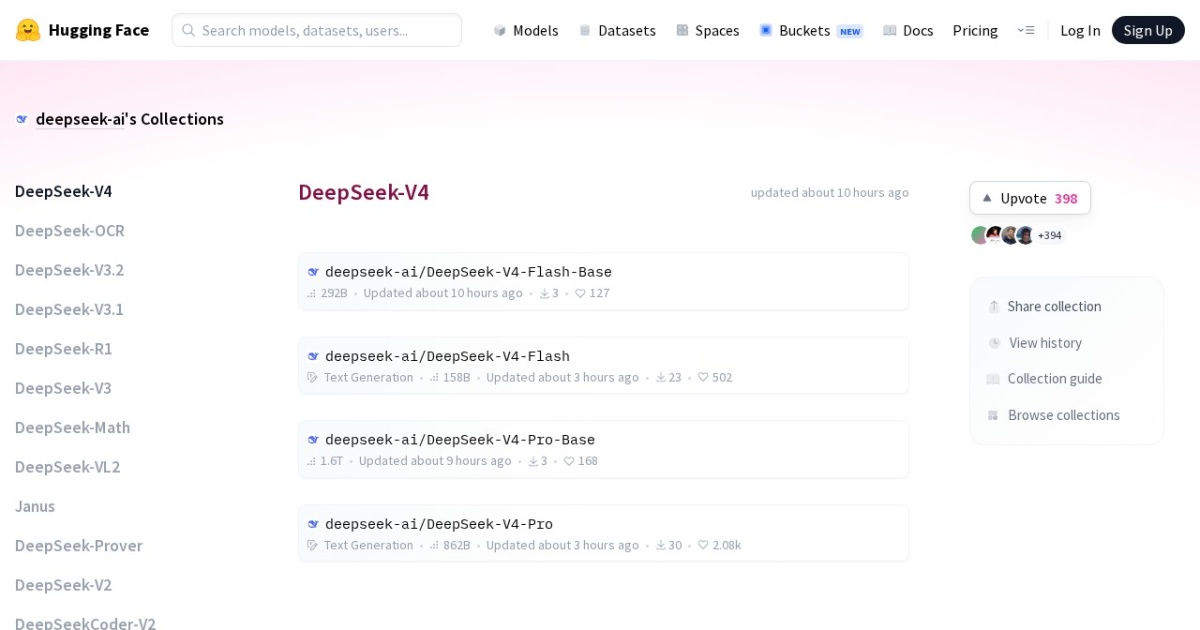
DeepSeek-V4 is relevant for builders comparing open-weight frontier-style models for coding agents, long-context analysis, and reasoning-heavy automation. The family currently centers on DeepSeek-V4-Pro for maximum capability and DeepSeek-V4-Flash for lower-cost, higher-throughput use, but both are still very large models that most solopreneurs will access through hosted inference or specialized infrastructure rather than a normal local workstation.
Official site: https://huggingface.co/collections/deepseek-ai/deepseek-v4
Company YouTube: No official company YouTube channel found during official-page review.
At a glance
| Pricing model | Free |
|---|---|
| Page type | Model family |
| Model source | Own models |
| API cost | No required vendor API cost for self-hosted weights; hosted inference pricing varies by provider and model variant. |
| Subscription cost | No mandatory subscription for open-weight access; hosted access is typically usage-based. |
| Model last update | 2026-04-24 (DeepSeek-V4 Hugging Face collection and model cards). |
| Model weight counts | 284B total / 13B active (DeepSeek-V4-Flash), 1.6T total / 49B active (DeepSeek-V4-Pro) |
| Model versions | DeepSeek-R1, DeepSeek-V4 preview, DeepSeek-V4-Flash, DeepSeek-V4-Pro |
| Related model | DeepSeek-R1 · DeepSeek-V4 vs DeepSeek-R1 |
| Key difference | DeepSeek-V4 shifts the DeepSeek catalog from a reasoning-specialist R1 release toward a broader 1M-context model family for coding, long-context, and agentic workflows. |
| Best for | Coding-agent experiments with open-weight models, Long-context analysis over documents or repositories, Teams evaluating self-hosted frontier-style LLM infrastructure |
| Categories | For Solopreneurs , For Small Business , Free AI Tools , Automation , Developers , Cloud LLMs , Local LLMs |
Model version timeline
Reasoning-focused predecessor that established DeepSeek's open-weight reasoning profile.
Source
DeepSeek published V4-Pro, V4-Flash, and base checkpoints with 1M context and MIT-licensed weights.
Source
Lower-throughput-cost V4 variant listed at 284B total parameters and 13B activated parameters.
Source
Largest V4 variant listed at 1.6T total parameters and 49B activated parameters.
Source
Top alternatives
- DeepSeek-R1 : Reasoning-focused open-weight family with MIT core licensing and smaller distilled options.
- Qwen3.6 : Qwen3.6 family covering the hosted Qwen3.6-Plus flagship and the first open-weight Qwen3.6-35B-A3B release.
- Qwen3.6-35B-A3B : First open-weight Qwen3.6 model: a 35B total / 3B active multimodal MoE focused on agentic coding and practical local use.
- Mistral Small 4 : Open hybrid Mistral model that combines instruct, reasoning, coding, OCR, and transcription in one 256K-context family.
- NVIDIA Nemotron : Open model family for agentic AI with reasoning-focused releases across edge, single-GPU, and multi-GPU tiers.
- Llama 4 : Open-weight multimodal family with massive context, but significant policy and license constraints.
Notes
DeepSeek-V4 is most useful when you need open-weight access to a very large long-context model family and can route simpler calls to Flash while reserving Pro for harder coding or reasoning work.
Comparison table
| Tool | Pricing | Page type | Model source | API cost | Subscription cost | Pros | Cons |
|---|---|---|---|---|---|---|---|
| DeepSeek-V4 | Free | Model family | Own models | No required vendor API cost for self-hosted weights; hosted inference pricing varies by provider and model variant. | No mandatory subscription for open-weight access; hosted access is typically usage-based. | 1M-token context supports large document, repo, and agent traces; Pro and Flash variants make capability-versus-cost routing easier | Even Flash is too large for ordinary local machines; Preview releases can have immature runtime support and changing provider availability |
| DeepSeek-R1 | Free | Model family | Own models | No required vendor API cost for local/self-hosted use. | No mandatory subscription for base model access. | MIT core licensing is commercially friendly; Strong reasoning orientation for analytical tasks | Flagship model sizes are impractical for most solo local setups; Distill licensing can vary based on upstream model lineage |
| Qwen3.6 | Free | Model family | Own models | Qwen3.6-Plus in Model Studio is listed at $0.5-$2 input and $3-$6 output per 1M tokens depending on context tier; open-weight variants do not require vendor API spending for local use. | No mandatory subscription for open-weight access; hosted Qwen3.6-Plus is usage-based in Model Studio. | Covers both hosted frontier use and practical local deployment paths; Qwen3.6-Plus pushes 1M-context agentic coding and multimodal reasoning | Family messaging is now split between hosted and open branches, which is less simple than Qwen3.5; Hosted pricing and behavior differ from the local open-weight experience |
| Qwen3.6-35B-A3B | Free | Model family | Own models | No required vendor API cost for local/self-hosted use. | No mandatory subscription for base model access. | Much more practical than waiting for very large Qwen3.6 weights; Strong agentic coding uplift over the previous 35B-A3B branch | Still needs meaningful hardware compared with 8B-class local models; Hosted Qwen3.6-Plus remains the stronger top-end option if you can accept API dependence |
| Mistral Small 4 | Free | Model family | Own models | Mistral API lists Mistral Small 4 at $0.15 input / $0.60 output per 1M tokens. | No mandatory subscription for open-weight access; hosted API is pay-as-you-go. | One family covers reasoning, coding, OCR, and transcription; 256K context is practical for large document and repo workflows | Still much heavier than 7B to 14B local models; Fresh releases can have uneven runtime support at first |
| NVIDIA Nemotron | Free | Model family | Own models | No required vendor API cost for local/self-hosted use; hosted NIM/provider endpoints are usage-based. | No mandatory subscription for base open-model access. | Strong focus on reasoning and agentic workloads; Open model access with broad deployment flexibility | Best performance often assumes modern NVIDIA hardware; Model naming and lineup evolve quickly, requiring active tracking |
| Llama 4 | Free | Model family | Own models | No required vendor API cost for local/self-hosted use. | No mandatory subscription for base model access. | Very large context windows for repository- and corpus-level tasks; Multimodal support for text and image understanding | License includes attribution and derivative naming obligations; Additional licensing conditions can trigger at very large scale |
Internal links
Related best pages
- Best Free LLMs for Solopreneurs
- Best Free AI Tools for Solopreneurs
- Best AI Automation Tools
- Best AI Email Marketing Tools