
DeepSeek-R1 vs DeepSeek-V4
DeepSeek-V4 shifts the DeepSeek catalog from a reasoning-specialist R1 release toward a broader 1M-context model family for coding, long-context, and…
This comparison covers pricing, capabilities, and the best-fit use cases for each tool — so you can shortlist faster.
At a glance
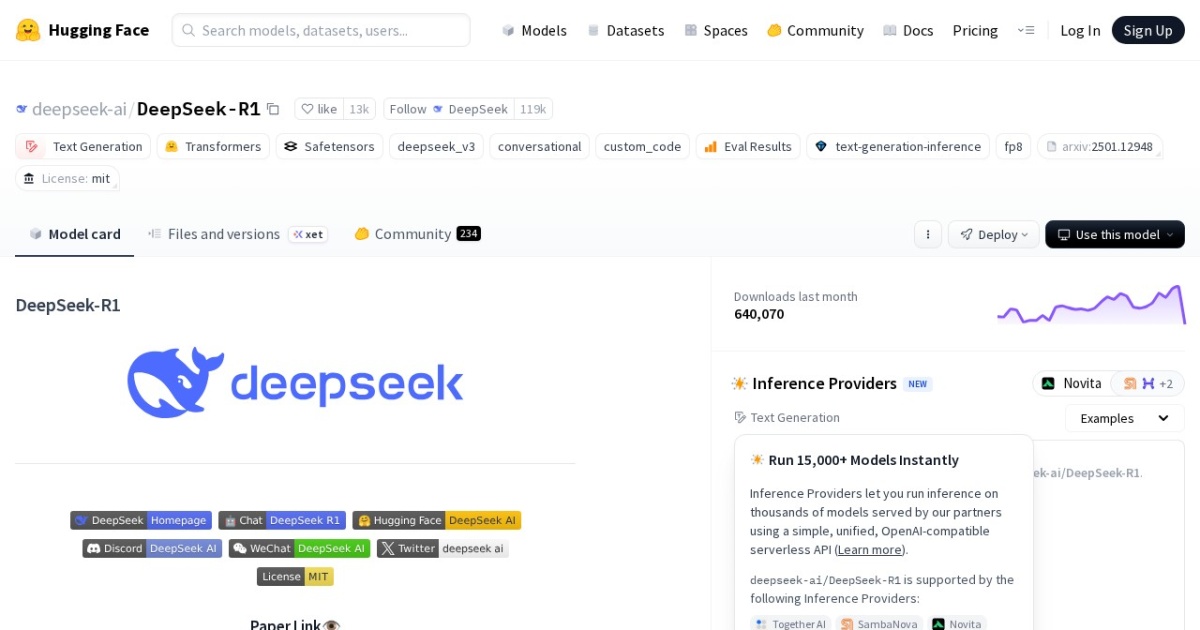
DeepSeek-R1
Reasoning-focused open-weight family with MIT core licensing and smaller distilled options.
DeepSeek-R1 is relevant for solopreneurs who want strong reasoning behavior in open-weight workflows. The flagship checkpoints are large, so practical use usually comes from smaller distills and careful license checks on inherited base models.
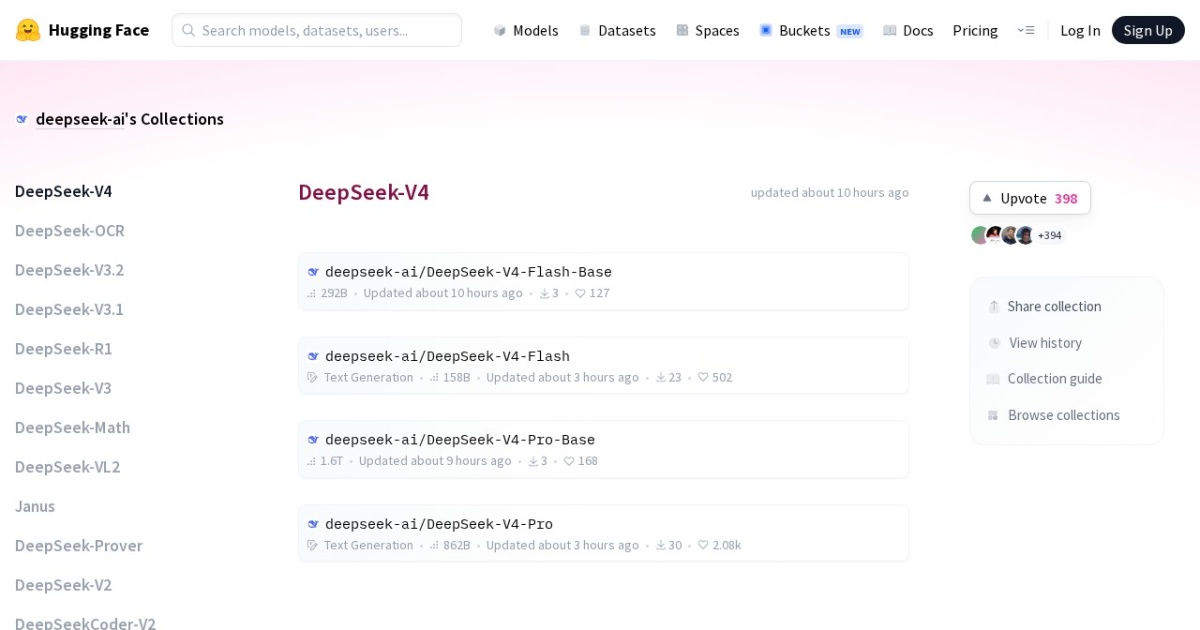
DeepSeek-V4
Preview open-weight DeepSeek family with Pro and Flash MoE models, 1M context, and strong coding and agentic reasoning focus.
DeepSeek-V4 is relevant for builders comparing open-weight frontier-style models for coding agents, long-context analysis, and reasoning-heavy automation. The family currently centers on DeepSeek-V4-Pro for maximum capability and DeepSeek-V4-Flash for lower-cost, higher-throughput use, but both are still very large models that most solopreneurs will access through hosted inference or specialized infrastructure rather than a normal local workstation.
Side-by-side comparison
| Dimension | DeepSeek-R1 | DeepSeek-V4 |
|---|---|---|
| Pricing model | Free | Free |
| Price range | Free (open weights) | Free (open weights) or usage-based through hosted providers |
| API cost | No required vendor API cost for local/self-hosted use. | No required vendor API cost for self-hosted weights; hosted inference pricing varies by provider and model variant. |
| Subscription cost | No mandatory subscription for base model access. | No mandatory subscription for open-weight access; hosted access is typically usage-based. |
| Pros | • MIT core licensing is commercially friendly • Strong reasoning orientation for analytical tasks • Distilled variants provide more practical deployment paths • API compatibility can simplify migration from other stacks | • 1M-token context supports large document, repo, and agent traces • Pro and Flash variants make capability-versus-cost routing easier • MIT-licensed model weights are commercially friendly • Strong positioning for coding agents and long-horizon reasoning tasks |
| Cons | • Flagship model sizes are impractical for most solo local setups • Distill licensing can vary based on upstream model lineage • Requires strict verification for business-critical outputs | • Even Flash is too large for ordinary local machines • Preview releases can have immature runtime support and changing provider availability • Text-only scope means image, audio, and video workflows need other models |
| Best for | • Reasoning-heavy workflows on distilled checkpoints • Local experimentation with open model pipelines • Teams that want OpenAI-style API integration patterns | • Coding-agent experiments with open-weight models • Long-context analysis over documents or repositories • Teams evaluating self-hosted frontier-style LLM infrastructure |
Key difference
DeepSeek-V4's perspective: DeepSeek-V4 shifts the DeepSeek catalog from a reasoning-specialist R1 release toward a broader 1M-context model family for coding, long-context, and agentic workflows.
When to pick each
Pick DeepSeek-R1 when
- Reasoning-heavy workflows on distilled checkpoints
- Local experimentation with open model pipelines
- Teams that want OpenAI-style API integration patterns
Pick DeepSeek-V4 when
- Coding-agent experiments with open-weight models
- Long-context analysis over documents or repositories
- Teams evaluating self-hosted frontier-style LLM infrastructure