
Voxtral TTS alternatives
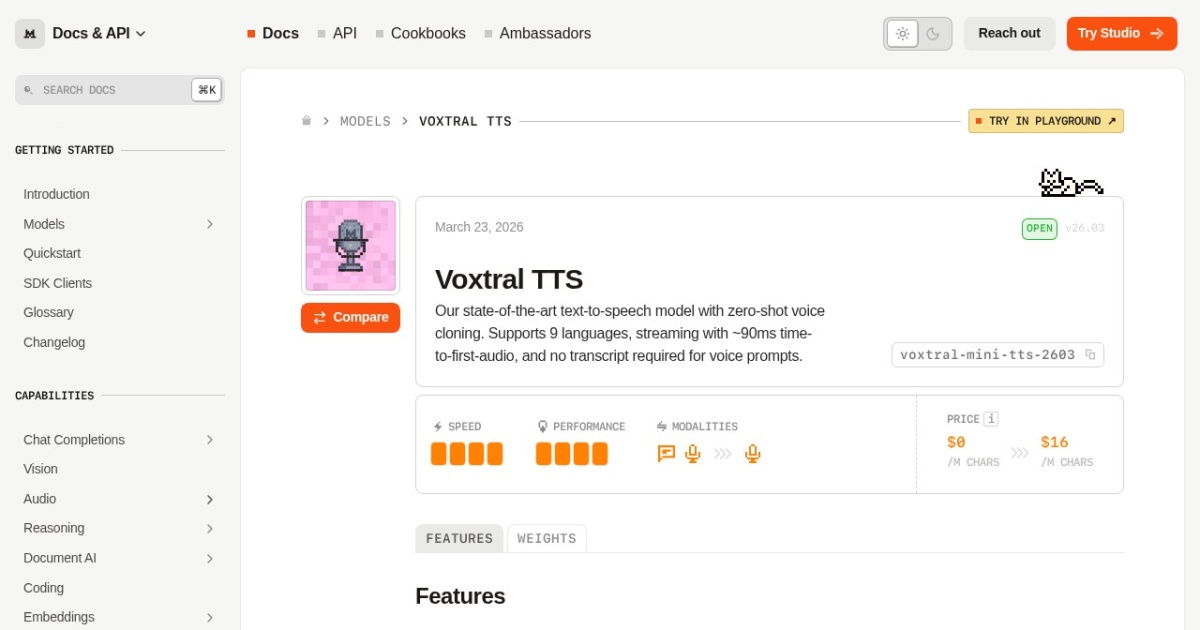
Mistral text-to-speech model with zero-shot voice cloning, low-latency streaming, and multilingual speech generation.
This Voxtral TTS alternatives guide compares pricing, strengths, tradeoffs, and related options.
Voxtral TTS is one of the clearest recent additions for the text-to-speech section because it gives Mistral a serious speech-generation entry rather than only transcription and general multimodal models. It is especially relevant for API-first builders who want low-latency speech, multilingual coverage, and voice cloning without having to manage a local node stack.
Official site: https://docs.mistral.ai/models/voxtral-tts-26-03
Company YouTube: No official company YouTube channel found during official-page review.
At a glance
| Pricing model | Credits |
|---|---|
| Page type | Product/service |
| Model source | Own models |
| Price range | Pay-as-you-go API |
| Model last update | 2026-03-23 (official Mistral model page: Voxtral TTS v26.03). |
| Best for | YouTube automation workflows, Faceless content production |
| Categories | For Creators , Video , Text to Speech |
TTS feature comparison
| Tool | Languages | Accents | Voice cloning | Voice changing | Local/offline | API access | Notes |
|---|---|---|---|---|---|---|---|
| Voxtral TTS | English, French, Spanish, Portuguese, Italian, Dutch, German, Hindi, Arabic. | Cross-lingual cloning and code-mixing are supported; accent and speaking style follow the reference voice prompt. | Yes | Partial | No | Yes | Strong fit for low-latency voice agents, branded voice workflows, and multilingual API-first narration systems. |
| ElevenLabs | Multi-language voice library with broad language coverage. | Broad accent and style coverage depending on selected voice model. | Yes | Yes | No | Yes | Strong all-round option for production voice quality and API workflows. |
| Murf | Multi-language support with provider-managed voice library. | Multiple accent options available across supported language voices. | Partial | Partial | No | Yes | Studio-oriented interface suitable for business narration pipelines. |
| ComfyUI TTS | Depends on selected custom node/model; multilingual support is available across several node packs. | Depends on voice packs and model families used by each custom node. | Partial | Partial | Yes | Partial | Best for advanced users who want node-level control over TTS pipelines. |
| Kokoro TTS | Multilingual capability depends on selected checkpoints and runtime implementation. | Accent support is model/checkpoint dependent. | No | No | Yes | Partial | Good for lightweight local experimentation and custom integrations. |
| Piper TTS | Multi-language support via community and packaged voice models. | Accent availability depends on installed voice packs and language models. | No | No | Yes | Partial | Best for offline, scriptable, low-cost narration pipelines. |
Top alternatives
- ElevenLabs : Natural text-to-speech platform for voiceovers and narration.
- Murf : Studio-style AI voiceover tool with tone and pacing controls.
- ComfyUI TTS : Node-based text-to-speech and voice workflow stack inside ComfyUI using custom audio nodes.
- Kokoro TTS : Compact open-weight TTS model for local voice synthesis and experimentation.
- Piper TTS : Fast local neural text-to-speech engine for offline voice generation.
Notes
Voxtral TTS is a high-signal addition for teams that want a modern API speech model with voice cloning and faster streaming than older creator-first voiceover tools.
Comparison table
| Tool | Pricing | Page type | Model source | Price range | API cost | Subscription cost | Pros | Cons |
|---|---|---|---|---|---|---|---|---|
| Voxtral TTS | Credits | Product/service | Own models | Pay-as-you-go API | Mistral lists Voxtral TTS at $0 input / $16 output per 1M characters. | No mandatory subscription is listed on the model page; usage is pay-as-you-go through Mistral API. | Zero-shot voice cloning needs very short reference audio; Low latency is attractive for real-time voice agents | No local/offline path on the official release; API usage cost can add up for heavy narration volumes |
| ElevenLabs | Freemium | Product/service | Own models | Free-$330+/mo | Usage-based API pricing is available; total cost depends on model, character volume, and selected plan. | Free tier available; paid subscriptions unlock higher limits, cloning depth, and team features. | Fast setup for solo teams; Useful template support for repeatable workflows | Costs can increase with higher usage; Output quality depends on prompt quality |
| Murf | Subscription | Product/service | Own models | $29-$99+/mo | API access is plan-dependent; usage and integration pricing depend on the selected business tier. | Paid subscription required for sustained production use; pricing starts with standard creator/business plans. | Fast setup for solo teams; Useful template support for repeatable workflows | Costs can increase with higher usage; Output quality depends on prompt quality |
| ComfyUI TTS | Free | Open-source project | 3rd-party models | Free (open-source) | No required vendor API cost for local/self-hosted use. | No mandatory subscription for the open-source local workflow; hosted runtimes and third-party models can add separate cost. | Full node-level control for reusable speech workflows; Strong custom-node ecosystem for multiple TTS model families | Setup and dependency management can be technical; Node compatibility and model updates require maintenance |
| Kokoro TTS | Free | Open-source project | 3rd-party models | Free (open weights) | No required vendor API cost for local/self-hosted use. | No mandatory subscription for base model access. | Small model footprint for local usage; Open-weight flexibility for custom pipelines | Requires model/runtime setup and tuning; Fewer turnkey UX features than hosted products |
| Piper TTS | Free | Open-source project | 3rd-party models | Free (open-source) | No required vendor API cost for local/self-hosted use. | No mandatory subscription for base model access. | Fully local and offline voice generation; Lightweight runtime suitable for automation pipelines | Voice quality varies by selected model/voice pack; Setup is more technical than hosted TTS apps |
Internal links
Related best pages
- Best AI Voiceover Tools
- Best AI Tools for YouTube Shorts
- Best AI Video Repurposing Tools
- Best AI Script Generators