
Kokoro TTS alternatives
Compact open-weight TTS model for local voice synthesis and experimentation.
This Kokoro TTS alternatives guide compares pricing, strengths, tradeoffs, and related options.
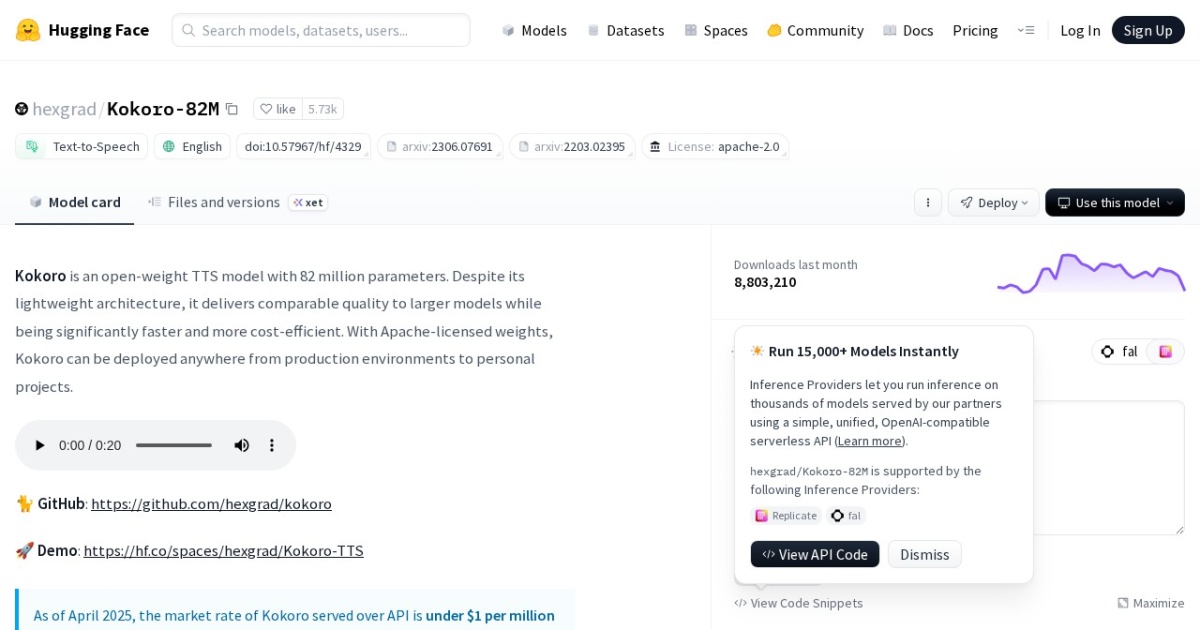
Kokoro TTS is included in this directory because it offers a small, free local model option for creators building custom speech workflows.
Official site: https://huggingface.co/hexgrad/Kokoro-82M
Company YouTube: No official company YouTube channel found during official-page review.
At a glance
| Pricing model | Free |
|---|---|
| Page type | Open-source project |
| Model source | 3rd-party models |
| API cost | No required vendor API cost for local/self-hosted use. |
| Subscription cost | No mandatory subscription for base model access. |
| Best for | Lightweight local text-to-speech experiments |
| Categories | For Solopreneurs , For Small Business , Video , Text to Speech , Free AI Tools , Local LLMs |
TTS feature comparison
| Tool | Languages | Accents | Voice cloning | Voice changing | Local/offline | API access | Notes |
|---|---|---|---|---|---|---|---|
| Kokoro TTS | Multilingual capability depends on selected checkpoints and runtime implementation. | Accent support is model/checkpoint dependent. | No | No | Yes | Partial | Good for lightweight local experimentation and custom integrations. |
| Piper TTS | Multi-language support via community and packaged voice models. | Accent availability depends on installed voice packs and language models. | No | No | Yes | Partial | Best for offline, scriptable, low-cost narration pipelines. |
| Coqui TTS | Broad multilingual support across available Coqui-compatible models. | Accent support is available through model and speaker selection. | Yes | Partial | Yes | Yes | Strong flexibility for advanced custom speech systems. |
| Voicebox | Depends on selected model and voice workflow; multilingual support is available via compatible model stacks. | Accent support depends on selected model checkpoints and reference voice data. | Yes | Yes | Yes | Yes | Strong fit for local voice cloning and multi-speaker project workflows. |
| ElevenLabs | Multi-language voice library with broad language coverage. | Broad accent and style coverage depending on selected voice model. | Yes | Yes | No | Yes | Strong all-round option for production voice quality and API workflows. |
Top alternatives
- Piper TTS : Fast local neural text-to-speech engine for offline voice generation.
- Coqui TTS : Open-source toolkit for local text-to-speech and voice cloning workflows.
- Voicebox : Local-first open-source voice cloning studio powered by Qwen3-TTS.
- ElevenLabs : Natural text-to-speech platform for voiceovers and narration.
Notes
Kokoro TTS is useful when you want a smaller local TTS model with open-weight flexibility.
Comparison table
| Tool | Pricing | Page type | Model source | API cost | Subscription cost | Pros | Cons |
|---|---|---|---|---|---|---|---|
| Kokoro TTS | Free | Open-source project | 3rd-party models | No required vendor API cost for local/self-hosted use. | No mandatory subscription for base model access. | Small model footprint for local usage; Open-weight flexibility for custom pipelines | Requires model/runtime setup and tuning; Fewer turnkey UX features than hosted products |
| Piper TTS | Free | Open-source project | 3rd-party models | No required vendor API cost for local/self-hosted use. | No mandatory subscription for base model access. | Fully local and offline voice generation; Lightweight runtime suitable for automation pipelines | Voice quality varies by selected model/voice pack; Setup is more technical than hosted TTS apps |
| Coqui TTS | Free | Open-source project | 3rd-party models | No required vendor API cost for local/self-hosted use. | No mandatory subscription for base model access. | Broad feature set for custom TTS workflows; Local deployment and automation friendly | Higher setup complexity for non-technical users; Quality and latency vary by model and hardware |
| Voicebox | Free | Open-source project | 3rd-party models | No required vendor API cost for local/self-hosted use. | No mandatory subscription for base model access. | Full local-first control over voice assets and generation workflow; Strong fit for voice cloning and multi-voice composition | Setup quality depends on local hardware and model configuration; Early-stage project cadence can introduce workflow changes |
| ElevenLabs | Freemium | Product/service | Own models | Usage-based API pricing is available; total cost depends on model, character volume, and selected plan. | Free tier available; paid subscriptions unlock higher limits, cloning depth, and team features. | Fast setup for solo teams; Useful template support for repeatable workflows | Costs can increase with higher usage; Output quality depends on prompt quality |
Internal links
Related best pages
- Best AI Voiceover Tools
- Best AI Tools for YouTube Shorts
- Best AI Video Repurposing Tools
- Best Free LLMs for Solopreneurs