
LegalFly alternatives
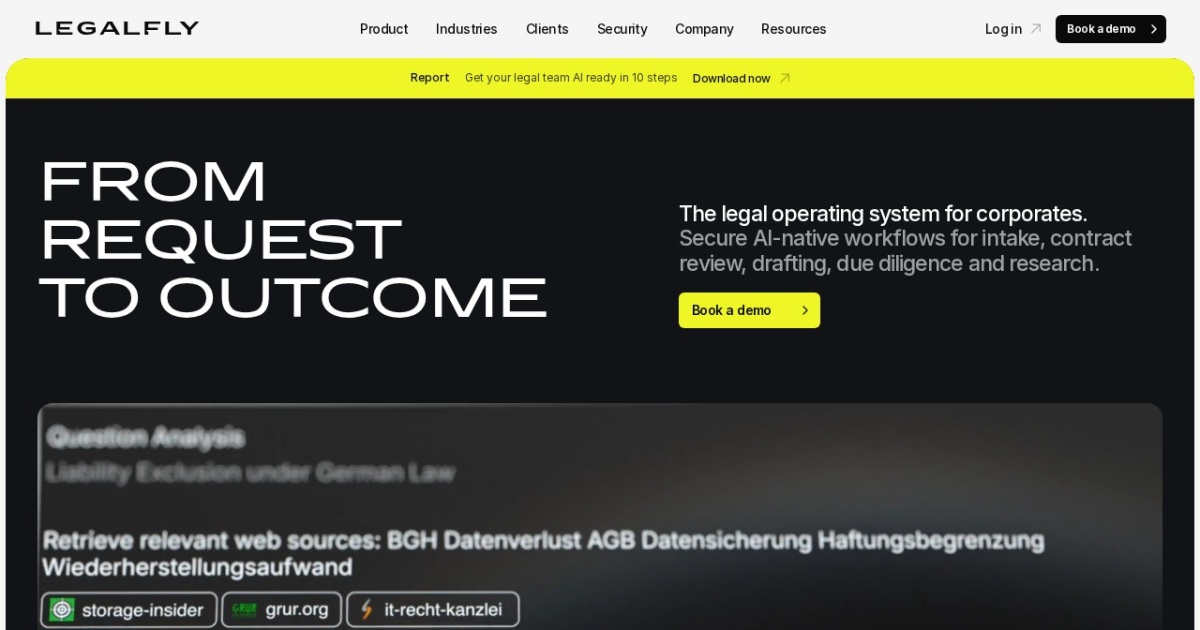
AI legal operating system for in-house teams — playbook-driven contract review, smart-template drafting, multi-document due diligence, legal research, and regulatory monitoring in 60+ jurisdictions. PII pseudonymized before analysis.
This LegalFly alternatives guide compares pricing, strengths, tradeoffs, and related options.
LegalFly is built specifically for in-house legal teams at enterprises rather than law firms — the difference matters because in-house workflows emphasize playbook consistency and risk monitoring over billable-hour optimization. The platform combines contract review with playbook-driven consistency, document drafting with smart templates, multi-document due diligence analysis, legal research grounded in verified sources, and regulatory monitoring across more than 60 jurisdictions. The 2026 differentiator is the privacy-first architecture — sensitive information is anonymized before any analysis and user data stays in the customer environment, which fits EU procurement requirements better than US-hosted competitors. Integrations cover Word, Teams, and SharePoint. ISO 27001 and SOC 2 Type II certifications. Built in Europe, trusted globally per the marketing. Customers include ECS and Duvel Moortgat.
Official site: https://www.legalfly.com/
At a glance
| Pricing model | Subscription |
|---|---|
| Page type | Product/service |
| Model source | 3rd-party models |
| Price range | Enterprise subscription (pricing not disclosed on marketing site) |
| Best for | In-house legal teams at EU enterprises with strict data-residency requirements, Banking, insurance, and technology compliance teams needing 60+ jurisdiction monitoring, Multi-document due diligence workflows for M&A or vendor reviews, Legal operations leads encoding playbooks for consistent contract review at scale |
| Categories | For Solopreneurs , For Small Business |
Top alternatives
- Agentset : Open-source RAG infrastructure for developers — document upload API, hybrid search, multimodal support, automatic citations, model-agnostic. Used by 1,500+ teams in medical AI, legal tech, and enterprise search.
- Super RAG : Open-source RAG infrastructure with summarization, retrieve/rerank, code interpreter, multi-format document ingestion, customizable chunking, and session-id caching — free on GitHub.
- HubSpot : CRM and marketing automation platform with AI tooling.
- Activepieces : Open-source automation and AI workflow platform with no-code builder, MCP support, and self-hosted deployment.
- AgentX : No-code multi-agent platform with RAG knowledge bases, LLM-agnostic routing (works with any LLM), and one-click deployment to web widgets, Slack, and Discord.
Notes
LegalFly is the practical pick for in-house legal teams at EU enterprises where PII-pseudonymization, multi-jurisdiction regulatory monitoring, and playbook-driven contract review are non-negotiable procurement requirements.
Where LegalFly wins
| Job to be done | LegalFly | Harvey / Spellbook / Ivo |
|---|---|---|
| In-house legal workflow with playbook-driven contract review | Built specifically for in-house | Law-firm-first products |
| EU data-residency for sensitive contracts | PII pseudonymization + data stays in customer env | US-hosted by default |
| Multi-jurisdiction regulatory monitoring (60+ jurisdictions) | Built-in | Usually US-focused |
| Native Word, Teams, SharePoint integrations | Direct connectors | Often web-app-only |
| Law-firm billable-hour workflow | Not the use case | Harvey wins |
| Free OSS contract analysis on top of existing infrastructure | Not the focus | Agentset wins for OSS RAG |
Decision shortcuts
- Pick LegalFly when the workflow is in-house legal at an EU enterprise with playbook + regulatory monitoring requirements.
- Pick Gavel Exec when the workflow is law firm + transactional attorneys working in Microsoft Word.
- Pick Agentset when the requirement is OSS RAG with automatic citations rather than a packaged legal platform.
- Pick Super RAG when you want pure retrieval primitives to build your own legal-tech stack.
Comparison table
| Tool | Pricing | Page type | Model source | Price range | Pros | Cons |
|---|---|---|---|---|---|---|
| LegalFly | Subscription | Product/service | 3rd-party models | Enterprise subscription (pricing not disclosed on marketing site) | PII pseudonymization architecture anonymizes sensitive data before analysis — data stays in customer environment; Built specifically for in-house legal teams, not law firms — playbook + risk monitoring focus fits in-house workflows | Enterprise-only target audience makes evaluation slow without sales engagement; Pricing entirely opaque on marketing site — not viable for solo lawyers or small firms |
| Agentset | Free | Open-source project | 3rd-party models | Free open-source (GitHub); user pays underlying LLM and vector-DB costs | Free open-source with 1,500+ teams in production use; Built-in chat AND search APIs — covers both retrieval surfaces with one codebase | Self-host operational burden; no managed cloud tier; Smaller community than incumbent RAG frameworks (LangChain, LlamaIndex) |
| Super RAG | Free | Open-source project | 3rd-party models | Free open-source (GitHub); user pays underlying LLM and vector-DB costs | Free and open-source on GitHub — no licensing or per-token vendor lock-in; Unified API covers summarization, retrieve/rerank, and code interpreter in one call | Self-hosting means operational responsibility for infrastructure and updates; No managed cloud tier — teams wanting hands-off operation must build their own deployment |
| HubSpot | Freemium | Product/service | 3rd-party models | Free-$3,600+/mo | Fast setup for solo teams; Useful template support for repeatable workflows | Costs can increase with higher usage; Output quality depends on prompt quality |
| Activepieces | Freemium | Open-source project | 3rd-party models | Free (self-hosted) + paid cloud plans | Open-source core with self-hosted deployment option; Strong automation builder with integrations and agent workflows | Initial setup and governance can be heavy for solo users; Complex flows still require testing and maintenance discipline |
| AgentX | Freemium | Product/service | 3rd-party models | Tiered: Basic / Standard / Premium (free tier available) | LLM-agnostic — switch between OpenAI, Claude, open-weight models without rebuilding agents; True no-code workflow makes agent teams accessible to non-developers | Specific tier prices not surfaced publicly upfront; Multi-agent orchestration trades flexibility for ease of use vs. coding the orchestration yourself (LangChain, AutoGen) |
Internal links
Related best pages
- Best Free LLMs for Solopreneurs
- Best Free AI Tools for Solopreneurs
- Best AI Automation Tools
- Best AI Email Marketing Tools