
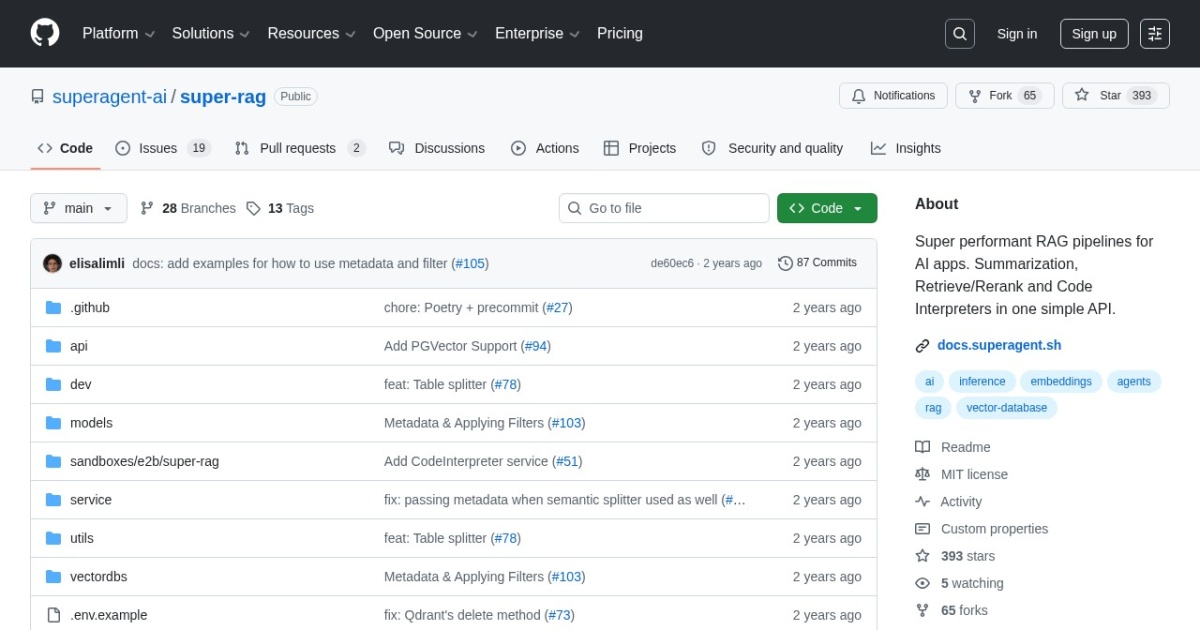
Super RAG alternatives
Open-source RAG infrastructure with summarization, retrieve/rerank, code interpreter, multi-format document ingestion, customizable chunking, and session-id caching — free on GitHub.
This Super RAG alternatives guide compares pricing, strengths, tradeoffs, and related options.
Super RAG ships production-ready retrieval-augmented generation pipelines through a unified API. The platform handles summarization, retrieve/rerank, and code interpreter calls in a single request flow, supports multiple document formats and vector databases, and lets teams configure chunking strategies and encoding models per workflow. Session management via unique identifiers enables effective caching so repeat queries don't re-embed the same content. The product is positioned as free and open source on GitHub, targeting developers who want enterprise-grade RAG capability without licensing barriers or per-token vendor fees beyond the LLM providers they choose.
Official site: https://github.com/superagent-ai/super-rag
Company YouTube: No official company YouTube channel found during official-page review.
At a glance
| Pricing model | Free |
|---|---|
| Page type | Open-source project |
| Model source | 3rd-party models |
| Price range | Free open-source (GitHub); user pays underlying LLM and vector-DB costs |
| Best for | Developer teams building production AI features with RAG and wanting code-level control, Privacy-sensitive operators who need self-hosted RAG infrastructure, Engineers comparing chunking and reranking strategies for their specific corpora, Indie hackers avoiding subscription pricing on RAG infrastructure |
| Categories | Free AI Tools , Developers |
Top alternatives
- Agentset : Open-source RAG infrastructure for developers — document upload API, hybrid search, multimodal support, automatic citations, model-agnostic. Used by 1,500+ teams in medical AI, legal tech, and enterprise search.
- OpenRouter : Unified API for routing requests across many third-party LLM providers and model families.
- Portkey AI Gateway : LLM gateway and control plane for multi-provider routing, reliability policies, and governance.
- AgentX : No-code multi-agent platform with RAG knowledge bases, LLM-agnostic routing (works with any LLM), and one-click deployment to web widgets, Slack, and Discord.
Notes
Super RAG is the practical pick when the workflow needs production RAG infrastructure under your own control — and the team prefers OSS over a managed vendor relationship.
Where Super RAG wins
| Job to be done | Super RAG | Managed RAG vendor |
|---|---|---|
| Self-host RAG infrastructure with no vendor lock-in | Free OSS, run on your hardware | Subscription required |
| Tune chunking and reranking per corpus | Configurable per workflow | Often opaque defaults |
| Cache repeat queries via session IDs | Built into the API | Not always exposed |
| Hands-off managed RAG operation | Not the focus — self-host required | Agentset provides managed RAG |
| Multi-agent orchestration on top | Out of scope | AgentX or LangChain better fit |
Decision shortcuts
- Pick Super RAG when the team self-hosts AI infrastructure and wants OSS with no subscription costs.
- Pick Agentset when you want the same OSS angle but with a more chat/search API surface.
- Pick OpenRouter when the bottleneck is multi-provider model routing rather than RAG specifically.
- Pick AgentX when no-code agent orchestration around RAG is what you actually need.
Comparison table
| Tool | Pricing | Page type | Model source | Price range | API cost | Subscription cost | Pros | Cons |
|---|---|---|---|---|---|---|---|---|
| Super RAG | Free | Open-source project | 3rd-party models | Free open-source (GitHub); user pays underlying LLM and vector-DB costs | No vendor fee for Super RAG itself. Pay underlying model and vector-DB providers at standard rates. | No required subscription. Self-host the OSS code or run it alongside existing AI infrastructure. | Free and open-source on GitHub — no licensing or per-token vendor lock-in; Unified API covers summarization, retrieve/rerank, and code interpreter in one call | Self-hosting means operational responsibility for infrastructure and updates; No managed cloud tier — teams wanting hands-off operation must build their own deployment |
| Agentset | Free | Open-source project | 3rd-party models | Free open-source (GitHub); user pays underlying LLM and vector-DB costs | No vendor fee for Agentset. Underlying LLM and vector-DB costs are pass-through. | No required subscription. Self-host the OSS code. | Free open-source with 1,500+ teams in production use; Built-in chat AND search APIs — covers both retrieval surfaces with one codebase | Self-host operational burden; no managed cloud tier; Smaller community than incumbent RAG frameworks (LangChain, LlamaIndex) |
| OpenRouter | Credits | Gateway/API aggregator | 3rd-party models | Usage-based credits | Usage-based API pricing; costs depend on model/provider selection. | No mandatory subscription listed for basic pay-as-you-go access. | One API for broad model and provider coverage; Practical fallback routing and uptime resilience | Final cost depends on provider/model routing choices; Behavior can vary between providers for the same model family |
| Portkey AI Gateway | Freemium | Gateway/API aggregator | 3rd-party models | Free tier + paid usage | Usage-based; includes underlying provider model costs. | Free tier available; paid plans for higher limits and advanced controls. | Centralized gateway for multi-provider model access; Strong policy, reliability, and observability orientation | Extra gateway layer adds platform complexity; Total cost still includes underlying model providers |
| AgentX | Freemium | Product/service | 3rd-party models | Tiered: Basic / Standard / Premium (free tier available) | Agents call user-selected LLMs; LLM-provider token costs are passed through. AgentX's own pricing covers the agent runtime and deployment infrastructure. | Tiered subscription model with a free Basic tier; Standard and Premium add higher agent limits, deployment endpoints, and team features. | LLM-agnostic — switch between OpenAI, Claude, open-weight models without rebuilding agents; True no-code workflow makes agent teams accessible to non-developers | Specific tier prices not surfaced publicly upfront; Multi-agent orchestration trades flexibility for ease of use vs. coding the orchestration yourself (LangChain, AutoGen) |