
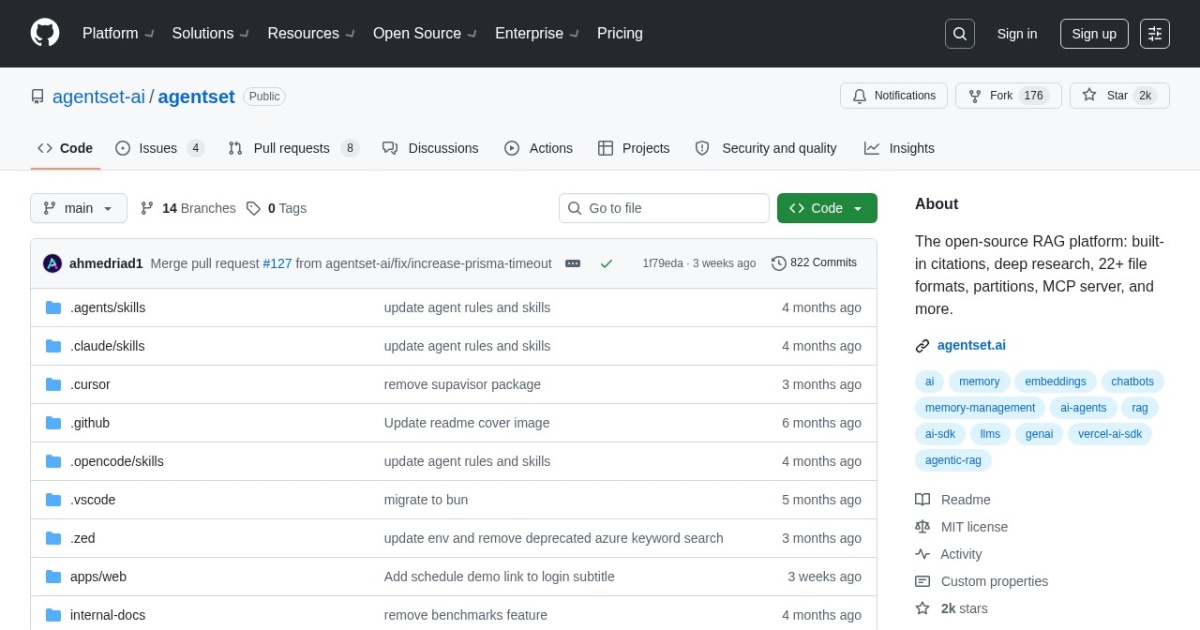
Agentset alternatives
Open-source RAG infrastructure for developers — document upload API, hybrid search, multimodal support, automatic citations, model-agnostic. Used by 1,500+ teams in medical AI, legal tech, and enterprise search.
This Agentset alternatives guide compares pricing, strengths, tradeoffs, and related options.
Agentset is open-source RAG infrastructure that ships with chat and search APIs out of the box, plus hybrid search (lexical + semantic), multimodal document support, and automatic citation generation for compliance-sensitive use cases like medical AI and legal tech. The platform is model-agnostic — pick any LLM and vector store. Document upload happens via API rather than requiring a managed UI, fitting engineering teams building AI features into their own products. The project launched in 2026 and reports 1,500+ teams in active use, with the canonical surface being the GitHub repo rather than a SaaS console.
Official site: https://github.com/agentset-ai/agentset
Company YouTube: No official company YouTube channel found during official-page review.
At a glance
| Pricing model | Free |
|---|---|
| Page type | Open-source project |
| Model source | 3rd-party models |
| Price range | Free open-source (GitHub); user pays underlying LLM and vector-DB costs |
| Best for | Developers building AI chat or search features into their own SaaS products, Medical AI, legal tech, and compliance-sensitive teams needing automatic citations, Engineering teams wanting OSS RAG with hybrid search out of the box, Operators evaluating Super RAG who also want a chat API surface |
| Categories | Free AI Tools , Developers |
Top alternatives
- Super RAG : Open-source RAG infrastructure with summarization, retrieve/rerank, code interpreter, multi-format document ingestion, customizable chunking, and session-id caching — free on GitHub.
- OpenRouter : Unified API for routing requests across many third-party LLM providers and model families.
- Portkey AI Gateway : LLM gateway and control plane for multi-provider routing, reliability policies, and governance.
- AgentX : No-code multi-agent platform with RAG knowledge bases, LLM-agnostic routing (works with any LLM), and one-click deployment to web widgets, Slack, and Discord.
Notes
Agentset is the practical pick when the workflow is “I need both RAG-backed chat AND search in my product, with optional citations” — and the team wants OSS rather than a vendor relationship.
Where Agentset wins
| Job to be done | Agentset | Super RAG | Managed RAG vendor |
|---|---|---|---|
| Chat API for a RAG-backed assistant | Built in | Build it yourself on top | Available, but vendor lock-in |
| Search API for hybrid retrieval | Built in | Available | Often a separate product |
| Medical / legal use cases needing automatic citations | Built in | Custom citation layer required | Usually feasible |
| Multimodal document ingestion | Built in | Limited | Varies |
| Pure RAG primitive (just retrieve+rerank) | Heavier than needed | Lighter, better fit | Overkill |
Decision shortcuts
- Pick Agentset when you need both chat AND search APIs in one OSS package, especially with citation requirements.
- Pick Super RAG when the focus is pure RAG primitives without the chat/search wrapper.
- Pick AgentX when no-code multi-agent orchestration is the bottleneck, not RAG specifically.
- Pick OpenRouter when multi-provider model routing matters more than RAG itself.
Comparison table
| Tool | Pricing | Page type | Model source | Price range | API cost | Subscription cost | Pros | Cons |
|---|---|---|---|---|---|---|---|---|
| Agentset | Free | Open-source project | 3rd-party models | Free open-source (GitHub); user pays underlying LLM and vector-DB costs | No vendor fee for Agentset. Underlying LLM and vector-DB costs are pass-through. | No required subscription. Self-host the OSS code. | Free open-source with 1,500+ teams in production use; Built-in chat AND search APIs — covers both retrieval surfaces with one codebase | Self-host operational burden; no managed cloud tier; Smaller community than incumbent RAG frameworks (LangChain, LlamaIndex) |
| Super RAG | Free | Open-source project | 3rd-party models | Free open-source (GitHub); user pays underlying LLM and vector-DB costs | No vendor fee for Super RAG itself. Pay underlying model and vector-DB providers at standard rates. | No required subscription. Self-host the OSS code or run it alongside existing AI infrastructure. | Free and open-source on GitHub — no licensing or per-token vendor lock-in; Unified API covers summarization, retrieve/rerank, and code interpreter in one call | Self-hosting means operational responsibility for infrastructure and updates; No managed cloud tier — teams wanting hands-off operation must build their own deployment |
| OpenRouter | Credits | Gateway/API aggregator | 3rd-party models | Usage-based credits | Usage-based API pricing; costs depend on model/provider selection. | No mandatory subscription listed for basic pay-as-you-go access. | One API for broad model and provider coverage; Practical fallback routing and uptime resilience | Final cost depends on provider/model routing choices; Behavior can vary between providers for the same model family |
| Portkey AI Gateway | Freemium | Gateway/API aggregator | 3rd-party models | Free tier + paid usage | Usage-based; includes underlying provider model costs. | Free tier available; paid plans for higher limits and advanced controls. | Centralized gateway for multi-provider model access; Strong policy, reliability, and observability orientation | Extra gateway layer adds platform complexity; Total cost still includes underlying model providers |
| AgentX | Freemium | Product/service | 3rd-party models | Tiered: Basic / Standard / Premium (free tier available) | Agents call user-selected LLMs; LLM-provider token costs are passed through. AgentX's own pricing covers the agent runtime and deployment infrastructure. | Tiered subscription model with a free Basic tier; Standard and Premium add higher agent limits, deployment endpoints, and team features. | LLM-agnostic — switch between OpenAI, Claude, open-weight models without rebuilding agents; True no-code workflow makes agent teams accessible to non-developers | Specific tier prices not surfaced publicly upfront; Multi-agent orchestration trades flexibility for ease of use vs. coding the orchestration yourself (LangChain, AutoGen) |