Granola alternatives
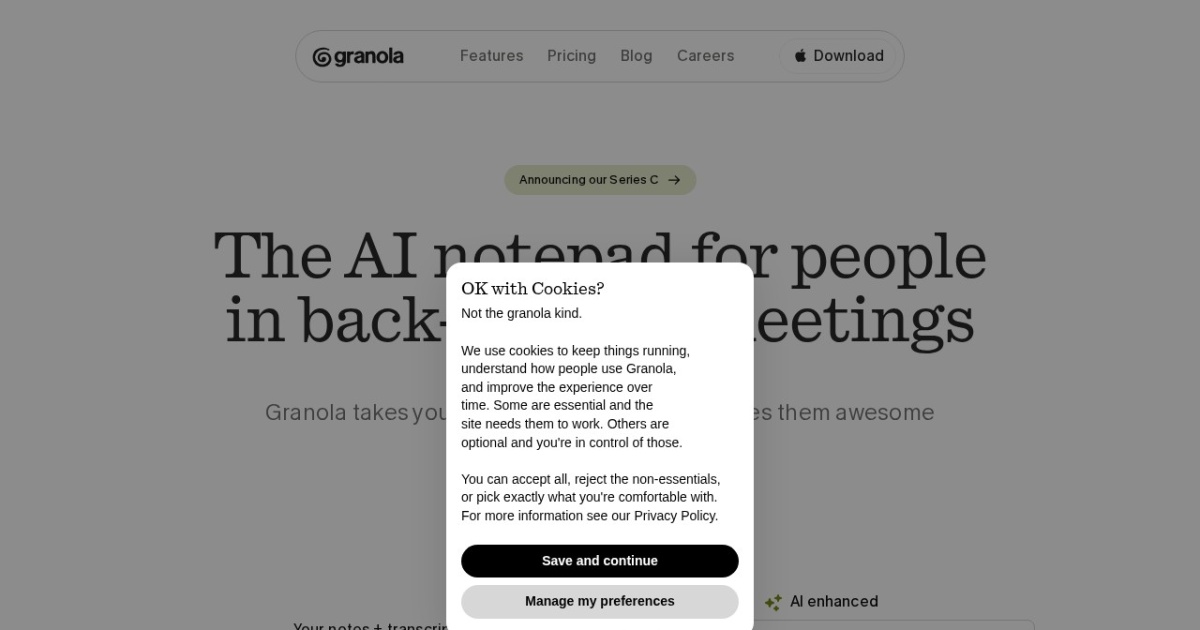
AI notepad for back-to-back meetings — writes alongside your own typed notes during the call, then produces a structured summary without joining as a recording bot.
This Granola alternatives guide compares pricing, strengths, tradeoffs, and related options.
Granola is positioned for people in back-to-back meetings — its design assumes you take some notes manually and want AI to fill in the gaps rather than replace the practice entirely. Unlike bot-based notetakers (Otter, Fireflies, tl;dv) that join meetings as a participant, Granola captures system audio locally and writes a structured summary alongside the user's own typed shorthand. The result reads more like a thoughtful prepared note than a verbatim transcript. The tool has become an indie-darling among solo founders, executives, and consultants in 2026; the team is small and responsive to community feedback on Product Hunt and Twitter.
Official site: https://granola.ai/
At a glance
| Pricing model | Freemium |
|---|---|
| Page type | Product/service |
| Model source | 3rd-party models |
| Price range | Free tier with monthly meeting cap + paid Pro and Business subscriptions |
| Best for | Solo executives and founders in back-to-back meeting days, Consultants who want AI-summarized notes without losing their own note-taking practice, Solopreneurs replacing transcription tools that joined as recording bots, Knowledge workers who want short structured summaries rather than verbatim transcripts |
| Categories | For Solopreneurs , For Small Business , Writing , Free AI Tools , Automation , Developers |
Top alternatives
- Anarlog : Open-source on-device AI notepad for meetings — local transcription, BYO API keys, notes saved as portable files. Formerly Hyprnote; canonical brand is now Anarlog.
- Plaud Note : ChatGPT-powered hardware voice recorder + companion app — captures meetings, calls, and memos, then transcribes and summarizes them into mind maps, notes, and to-do lists.
- tl;dv : AI meeting recorder for Zoom, Google Meet, and Teams — transcription in 30+ languages, AI summaries, timestamp tagging, clip-sharing. Generous free tier with unlimited recordings.
- Jellypod : AI podcast studio with multi-host dialogue (up to 4 hosts), voice cloning, PDF/URL/document ingestion, 30+ languages, video captions, and distribution to Spotify, Apple Podcasts, and YouTube.
- Descript : Text-based video and audio editor for narration, clips, and captions.
Notes
Granola is the practical pick for solo professionals in back-to-back meetings who want AI summaries that complement their own typed notes — without a visible recording bot joining the call.
Where Granola wins
| Job to be done | Granola | Bot-based notetakers (tl;dv, Otter) |
|---|---|---|
| Take meeting notes without a visible recording bot | System-audio capture, no bot joins | Bot joins as a participant |
| Combine my own typed shorthand with AI-summarized output | Headline workflow | Usually full-transcript only |
| Structured summary that reads like prepared notes | Yes, designed for that | Verbatim transcript with AI summary tacked on |
| Asynchronous catch-up on meetings I missed | Less effective — requires you to be there | tl;dv wins |
| Full offline / on-device privacy | Decent but cloud-touched | Anarlog wins |
Decision shortcuts
- Pick Granola when you attend most meetings and want AI to enhance your own notes, not replace them.
- Pick Anarlog when on-device privacy and OSS auditability matter more than UX polish.
- Pick tl;dv when the workflow is “I miss a lot of meetings and need post-meeting catch-up.”
- Pick Plaud Note when you want hardware-plus-software for capturing in-person conversations.
Comparison table
| Tool | Pricing | Page type | Model source | Price range | API cost | Subscription cost | Pros | Cons |
|---|---|---|---|---|---|---|---|---|
| Granola | Freemium | Product/service | 3rd-party models | Free tier with monthly meeting cap + paid Pro and Business subscriptions | API access details not publicly surfaced in 2026. Platform is operator-facing for individual professionals. | Free tier covers low-volume users; Pro tier covers solo professionals at moderate meeting volume; Business tier covers team workflows. | Captures system audio locally rather than joining the meeting as a visible bot — preserves the meeting feel; Designed for the user-still-takes-notes workflow rather than pure transcription replacement | System audio capture only works on platforms with the desktop app installed; Bot-based notetakers (tl;dv, Otter) still beat Granola for asynchronous "I missed the call" use cases |
| Anarlog | Free | Open-source project | 3rd-party models | Free open-source software; user pays underlying LLM provider for summary calls (BYOK) | No vendor API fee. BYOK model means your existing OpenAI/Anthropic/Ollama account handles summary costs. | No subscription required. Donations or commercial-support tiers available; check the project for current options. | Open-source code inspectable on GitHub — privacy claims are auditable rather than asserted; On-device transcription means audio never leaves your machine | Less polished UX than commercial competitors like Granola; Self-hosting requires comfort with installing and updating desktop software |
| Plaud Note | One-time | Product/service | 3rd-party models | Hardware purchase (one-time) + companion app with free tier and paid Pro subscription | No public developer API surfaced. ChatGPT transcription happens via Plaud's cloud, not user's own API key. | Free tier with limited transcription minutes per month; Pro tier lifts the cap. | Hardware-plus-app design covers in-person meetings where laptop notetakers can't reach; Pocket-size form factor fits consultants, sales reps, and field workers | Requires carrying hardware — purely-app competitors (Granola) work on existing devices; Transcription happens in Plaud's cloud, not on-device — not for privacy-sensitive meetings |
| tl;dv | Freemium | Product/service | 3rd-party models | Free tier with unlimited recordings + paid Pro and Business tiers for advanced features | API access details vary by tier; check the tl;dv platform docs. | Free tier with unlimited recordings covers most solo professionals. Pro and Business tiers add AI capabilities and team workflows. | Unusually generous free tier — unlimited meeting recordings rather than a monthly cap; 30+ language transcription covers most international team workflows | Joins meetings as a visible bot — some participants find this intrusive; Cloud transcription means audio leaves your environment — privacy-sensitive teams should evaluate |
| Jellypod | Freemium | Product/service | 3rd-party models | Free (1,000 credits + unlimited episodes), Starter $29/mo, Creator $59/mo, Business $200/mo | Jellypod does not surface a developer API in marketing materials; the platform is operator/creator-facing rather than API-first. | Free tier covers low-volume creators; Starter ($29/mo) adds 2 voice clones; Creator ($59/mo) is the typical solo-podcaster tier; Business ($200/mo) adds up to 8 voice clones and priority support for teams. | Multi-host dialogue with up to 4 AI characters produces natural-sounding conversation, not single-voice narration; Voice cloning preserves host identity across episodes for brand consistency | No public developer API surface — operator-first, not programmatic; Credit model means heavy publishers can scale costs faster than a flat-fee plan |
| Descript | Subscription | Product/service | Own models | $12-$40+/seat/mo | Not a primary public API-priced TTS product; costs are mainly tied to Descript subscription plans. | Paid subscription tiers govern editing, overdub, and export limits. | Fast setup for solo teams; Useful template support for repeatable workflows | Costs can increase with higher usage; Output quality depends on prompt quality |
Internal links
Related best pages
- Best Free LLMs for Solopreneurs
- Best Free AI Tools for Solopreneurs
- Best AI Automation Tools
- Best AI Email Marketing Tools