
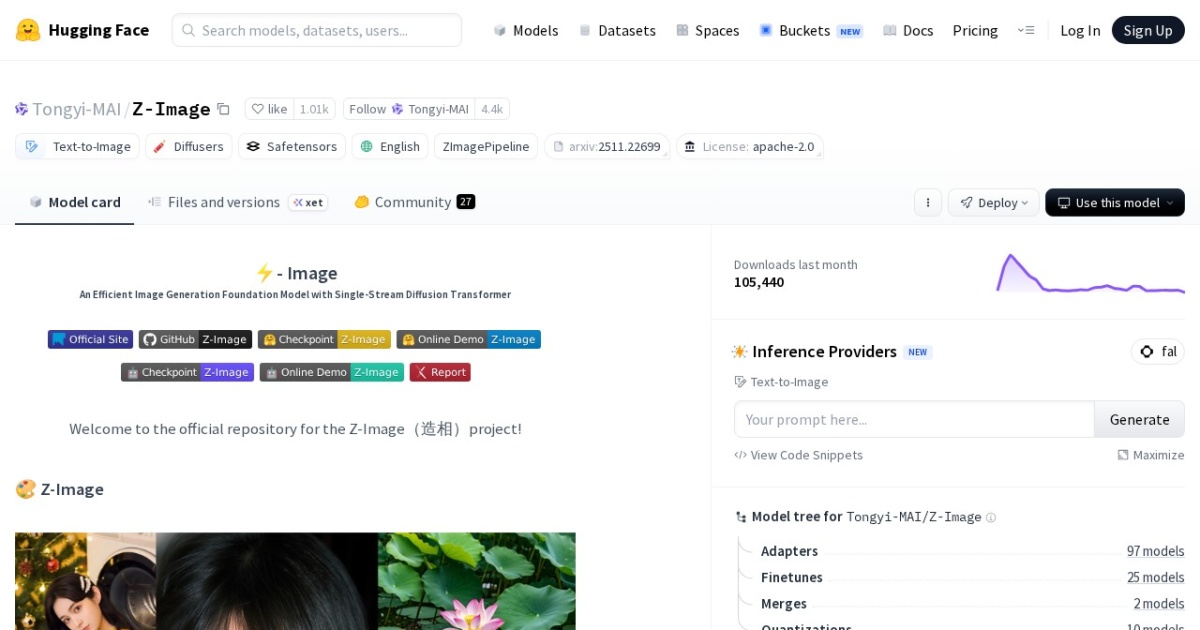
Z-Image alternatives
Z-Image text-to-image family for high-fidelity generation and fast iterative visual production.
This Z-Image alternatives guide compares pricing, strengths, tradeoffs, and related options.
Z-Image is listed as one model family page that covers the full-capacity base checkpoint and the Turbo distilled branch. Use this page to choose between higher controllability (base) and faster production latency (Turbo) for creator and solopreneur image workflows.
Official site: https://huggingface.co/Tongyi-MAI/Z-Image
Company YouTube: No official company YouTube channel found during official-page review.
At a glance
| Pricing model | Free |
|---|---|
| Page type | Model family |
| Model source | Own models |
| API cost | No mandatory vendor API fee for local/self-hosted use; hosted inference APIs are provider-priced. |
| Subscription cost | No required subscription for local open-weight use; hosted providers may offer paid plans. |
| Model last update | 2026-01-23 (latest visible checkpoint upload commit on Z-Image model files). |
| Model weight counts | 6B (Z-Image base), 6B (Z-Image-Turbo, distilled) |
| Model versions | Z-Image paper release, Z-Image base checkpoint, Z-Image-Turbo |
| Related model | Qwen Image · Z-Image vs Qwen Image |
| Key difference | Z-Image currently emphasizes base+turbo generation efficiency, while Qwen Image has a broader edit-branch lineup with monthly edit-focused checkpoints. |
| Supported image resolution | Up to 2048x2048 in standard pipelines (higher via tiling/workflow extensions). |
| Best for | Thumbnail and visual concept generation, Fast style exploration for creator content, Repeatable image and video content workflows |
| Categories | For Creators , For Solopreneurs , For Small Business , Video , Design , Image Generation , Free AI Tools , Local LLMs |
| ControlNet support |
|
Model version timeline
Top alternatives
- FLUX : FLUX family for quality-first generation, fast local variants, and modern in-context image editing workflows.
- HiDream : Open HiDream family for quality-focused generation and instruction-based image editing.
- Seedream : ByteDance Seedream family for high-quality text-to-image generation with multilingual prompt support.
- Qwen Image : Qwen text-to-image model family for generation, iterative editing, and text-heavy visual outputs.
- Stable Diffusion : Open model family for text-to-image generation, spanning v1.x, v2.x, SDXL, and SD3/SD3.5.
- Recraft : AI design tool for image generation, branded assets, and vector-first workflows.
- Leonardo AI : Image generation platform with style controls and asset variations.
- Midjourney : High-quality AI image generation for thumbnail concepts and visuals.
Notes
Z-Image is most useful when you want one family that can switch between quality-focused and latency-focused generation without changing ecosystem.
Z-Image Family Detailed Comparison
| Family branch | Model objective | Inference profile | Strengths | Tradeoffs | Best use cases | Source |
|---|---|---|---|---|---|---|
| Z-Image (base) | Full-capacity foundation generation | Higher compute, quality/control oriented | Better controllability headroom for complex prompt engineering, broad stylistic coverage, full-capacity training signal | Slower and heavier than turbo in production loops | High-quality key visuals, art direction passes, complex prompt variants | Model card |
| Z-Image-Turbo | Distilled high-efficiency generation | Low-step, latency-first profile | Very fast generation loops, strong practical quality at low NFEs, easier fit on smaller VRAM budgets | Less control headroom vs base for hardest prompt/control scenarios | Fast batch variants, thumbnail ideation, rapid campaign iterations | Model card |
Workflow-Level Comparison
| Workflow need | Recommended branch | Why |
|---|---|---|
| Maximum prompt control and style steering | Z-Image (base) | Preserves undistilled capacity and generally gives more room for fine-grained prompt behavior. |
| Fast iterative creative loops | Z-Image-Turbo | Distilled for speed and practical low-step inference. |
| Text-heavy poster/thumbnail drafts at scale | Start with Turbo, finalize on base | Turbo accelerates exploration; base can be used for final quality passes. |
| Local deployment with tighter VRAM limits | Z-Image-Turbo | Designed for stronger efficiency in constrained setups. |
For pipeline integration details (ZImagePipeline, ZImageImg2ImgPipeline, inpaint support), see Diffusers docs: Z-Image pipeline docs.
ControlNet Support
| Z-Image branch | ControlNet support | Common control types | Notes | Source |
|---|---|---|---|---|
| Z-Image (base) | Limited/early ecosystem support | Inpaint and image-to-image are officially documented; classic ControlNet type packs are currently ecosystem-dependent | Core official docs emphasize generation + img2img + inpaint; full SD-style ControlNet catalog is not broadly standardized yet. | Diffusers Z-Image docs |
| Z-Image-Turbo | Limited/early ecosystem support | Community adapters may expose Canny/Depth/Pose style controls depending on UI pack | Treat as adapter-specific support, not guaranteed parity across all runtimes. | Z-Image-Turbo model |
Comparison table
| Tool | Pricing | Page type | Model source | API cost | Subscription cost | Resolution | ControlNet | Pros | Cons |
|---|---|---|---|---|---|---|---|---|---|
| Z-Image | Free | Model family | Own models | No mandatory vendor API fee for local/self-hosted use; hosted inference APIs are provider-priced. | No required subscription for local open-weight use; hosted providers may offer paid plans. | Up to 2048x2048 in standard pipelines (higher via tiling/workflow extensions). |
| Clear family split between quality-first base and speed-first turbo; Strong practical fit for text-heavy thumbnail and poster generation | Large checkpoints still require careful VRAM planning for local use; Prompt quality and style control still need iterative tuning |
| FLUX | Free | Model family | Own models | Hosted API pricing is provider-dependent; local open-weight use has no mandatory vendor API fee. | No required subscription for local open-weight branches; hosted providers may offer paid tiers. | Commonly 1024x1024 native; higher outputs via high-res/tiling workflows (UI/provider dependent). |
| Strong family coverage from fast local generation to advanced iterative editing; Context-aware editing branch is practical for multi-turn visual workflows | License terms vary significantly across branches and must be checked per model; High-quality branches can require substantial VRAM for comfortable local runs |
| HiDream | Free | Open-source project | Own models | No required vendor API fee for local/self-hosted use; hosted endpoints are provider-dependent. | No mandatory subscription for open checkpoints; managed hosts may require paid plans. | Typically 1024x1024 baseline; higher resolutions depend on runtime and high-res passes. | Pipeline/adapters dependent; no single standardized full ControlNet pack across all branches | Open family covers both generation and instruction-based editing; Strong quality orientation with multiple runtime-size branches | Heavier branches need strong VRAM and tuning discipline; Tooling maturity can vary by UI/runtime integration |
| Seedream | Freemium | Model family | Own models | API pricing is endpoint/provider dependent; check selected provider pricing pages. | Free tiers may exist by provider; paid plans vary by endpoint and usage volume. | Provider-dependent; commonly 1024-2048 range in public endpoints. | Not standardized as a full classic ControlNet stack; provider/runtime dependent | Strong multilingual prompt and text rendering focus; Competitive quality profile in recent benchmark disclosures | Availability and hosting pathways vary by region/provider; Less transparent local-first workflow than fully open stacks |
| Qwen Image | Freemium | Model family | Own models | API pricing varies by hosting provider and selected model endpoint. | No mandatory subscription for local open-weight use; hosted plans may include monthly tiers. | Qwen-Image 2.0 adds native 2K output; older branches typically centered on 1024x1024 workflows plus scaling. |
| One family covers both clean generation and advanced editing; Strong text rendering quality for posters and thumbnail-style assets | Large checkpoints can still require significant VRAM for smooth local inference; Quality still depends on prompt and edit instruction precision |
| Stable Diffusion | Free | Model family | Own models | No mandatory vendor API fee for local/self-hosted use; hosted inference APIs are provider-priced. | No required subscription for local use of model weights; managed services may have paid plans. | Varies by branch: SD1.x/2.x commonly 512-768, SDXL 1024 native, SD3/3.5 often 1024+. |
| Broad model ecosystem from lightweight to high-quality variants; Strong community tooling across ComfyUI, AUTOMATIC1111, and Diffusers | Version licensing and access terms differ across releases; High-end variants need substantial VRAM for smooth inference |
| Recraft | Freemium | Product/service | Own models | API availability and pricing are plan-dependent; check current Recraft pricing/docs. | Free tier available; paid subscriptions unlock higher usage and team features. | Export/output size depends on plan and mode; high-res outputs available on paid tiers. |
| Strong fit for visual ideation and branded asset workflows; Useful balance of speed and output consistency for small teams | Advanced output quality still depends on prompt quality; Costs increase with heavier generation volume |
| Leonardo AI | Freemium | Product/service | 3rd-party models | API access is available with usage-based billing; effective cost depends on model and volume. | Free tier available; paid subscriptions add monthly token allowances and higher limits. | Commonly up to 1536-2048 output classes (model/plan dependent). |
| Fast setup for solo teams; Useful template support for repeatable workflows | Costs can increase with higher usage; Output quality depends on prompt quality |
| Midjourney | Subscription | Product/service | Own models | No public self-serve API is listed; access is primarily through Midjourney app/subscription workflows. | Paid subscription required for regular use; tiered monthly plans are available. | Square-first generation with upscale/export modes (effective outputs commonly 1024+ and above). |
| Strong aesthetic quality with minimal prompt complexity; Reliable option for concept art and thumbnail ideation | No true free tier for sustained use; Commercial throughput can get expensive at scale |
Internal links
Related best pages
- Best AI Video Repurposing Tools
- Best AI Thumbnail Generators
- Best AI Tools for YouTube Shorts
- Best Free LLMs for Solopreneurs