
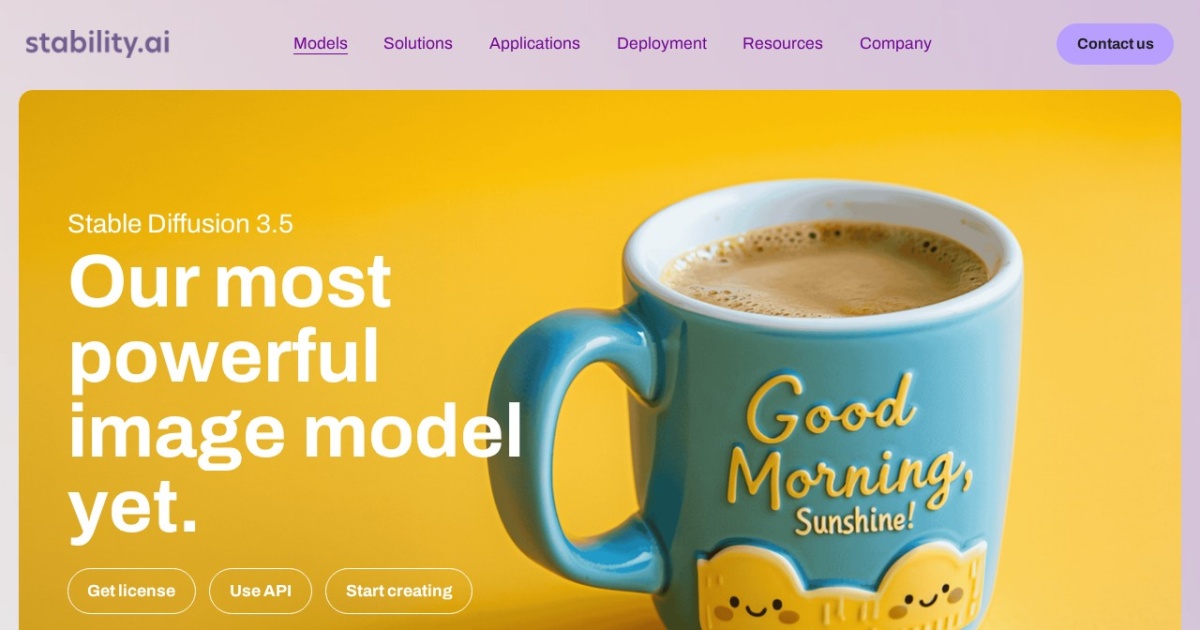
Stable Diffusion alternatives
Open model family for text-to-image generation, spanning v1.x, v2.x, SDXL, and SD3/SD3.5.
This Stable Diffusion alternatives guide compares pricing, strengths, tradeoffs, and related options.
Stable Diffusion is included in this directory as one unified tool family page covering multiple model generations (v1.x, v2.x, SDXL, SD3, and SD3.5) rather than separate entries per checkpoint. Use this page to compare licensing, compute needs, and workflow fit across versions before selecting a specific model line.
Official site: https://stability.ai/stable-diffusion
Company YouTube: https://www.youtube.com/@Stability_AI
At a glance
| Pricing model | Free |
|---|---|
| Page type | Model family |
| Model source | Own models |
| API cost | No mandatory vendor API fee for local/self-hosted use; hosted inference APIs are provider-priced. |
| Subscription cost | No required subscription for local use of model weights; managed services may have paid plans. |
| Model last update | 2024-10 (SD3.5 family release cadence) |
| Model weight counts | ~0.9B (Stable Diffusion v1.x), ~0.9B (Stable Diffusion v2.x), 2.6B (SDXL 1.0), 2B (Stable Diffusion 3 Medium), 8B (Stable Diffusion 3.5 Large), 8B (Stable Diffusion 3.5 Large Turbo), 2.5B (Stable Diffusion 3.5 Medium) |
| Model versions | Stable Diffusion v1.x, Stable Diffusion v2.x, SDXL 1.0, Stable Diffusion 3 (Medium), Stable Diffusion 3.5 (Large / Turbo / Medium) |
| Supported image resolution | Varies by branch: SD1.x/2.x commonly 512-768, SDXL 1024 native, SD3/3.5 often 1024+. |
| Best for | Faceless content production, Solopreneur operations |
| Categories | For Creators , For Solopreneurs , For Small Business , Video , Design , Image Generation , Free AI Tools , Local LLMs |
| ControlNet support |
|
Model version timeline
Stable Diffusion release milestones
2022-08
Stable Diffusion v1.x
Initial latent diffusion UNet releases.
Initial latent diffusion UNet releases.
2022-11
Stable Diffusion v2.x
OpenCLIP transition and higher native resolution variants.
OpenCLIP transition and higher native resolution variants.
2023-07
SDXL 1.0
Larger model line with 1024px-native workflows.
Larger model line with 1024px-native workflows.
2024-06
Stable Diffusion 3 (Medium)
MMDiT transformer architecture introduced in production release.
MMDiT transformer architecture introduced in production release.
2024-10
Stable Diffusion 3.5 (Large / Turbo / Medium)
Expanded SD3 family including high-capacity and turbo variants.
Expanded SD3 family including high-capacity and turbo variants.
Top alternatives
- FLUX : FLUX family for quality-first generation, fast local variants, and modern in-context image editing workflows.
- HiDream : Open HiDream family for quality-focused generation and instruction-based image editing.
- Ideogram : Text-centric image model family for posters, thumbnails, ads, and branded visual generation.
- Seedream : ByteDance Seedream family for high-quality text-to-image generation with multilingual prompt support.
- Midjourney : High-quality AI image generation for thumbnail concepts and visuals.
- Recraft : AI design tool for image generation, branded assets, and vector-first workflows.
- Leonardo AI : Image generation platform with style controls and asset variations.
- Adobe Firefly : Adobe AI image and design workflows for branded visuals.
- ComfyUI : Node-based image and video workflow builder for local and cloud generation pipelines.
- InvokeAI : Polished local-first generative image platform with strong workflow UX for Stable Diffusion users.
Notes
For a detailed version-by-version breakdown, see the Stable Diffusion model line guide.
ControlNet Support
| Stable Diffusion branch | ControlNet support | Common ControlNet types in real workflows | Notes | Source |
|---|---|---|---|---|
| SD 1.5 / SD 2.x | Yes (mature ecosystem) | Canny, Depth, OpenPose, Scribble, Lineart, SoftEdge/HED, MLSD, Segmentation, Tile, Normal | Most complete ecosystem coverage in community tooling and production recipes. | ControlNet repo |
| SDXL | Yes (widely available) | Canny, Depth, OpenPose, Tile, Scribble, Lineart (varies by provider/checkpoint pack) | Availability depends on which SDXL ControlNet pack your UI/provider ships. | Diffusers ControlNet docs |
| SD3 / SD3.5 | Partial (newer) | Canny, Blur, Depth (official SD3.5 ControlNets) | Official support exists but type coverage is narrower than SD1.5-era ecosystem breadth. | SD3.5 ControlNets |
Comparison table
| Tool | Pricing | Page type | Model source | API cost | Subscription cost | Resolution | ControlNet | Pros | Cons |
|---|---|---|---|---|---|---|---|---|---|
| Stable Diffusion | Free | Model family | Own models | No mandatory vendor API fee for local/self-hosted use; hosted inference APIs are provider-priced. | No required subscription for local use of model weights; managed services may have paid plans. | Varies by branch: SD1.x/2.x commonly 512-768, SDXL 1024 native, SD3/3.5 often 1024+. |
| Broad model ecosystem from lightweight to high-quality variants; Strong community tooling across ComfyUI, AUTOMATIC1111, and Diffusers | Version licensing and access terms differ across releases; High-end variants need substantial VRAM for smooth inference |
| FLUX | Free | Model family | Own models | Hosted API pricing is provider-dependent; local open-weight use has no mandatory vendor API fee. | No required subscription for local open-weight branches; hosted providers may offer paid tiers. | Commonly 1024x1024 native; higher outputs via high-res/tiling workflows (UI/provider dependent). |
| Strong family coverage from fast local generation to advanced iterative editing; Context-aware editing branch is practical for multi-turn visual workflows | License terms vary significantly across branches and must be checked per model; High-quality branches can require substantial VRAM for comfortable local runs |
| HiDream | Free | Open-source project | Own models | No required vendor API fee for local/self-hosted use; hosted endpoints are provider-dependent. | No mandatory subscription for open checkpoints; managed hosts may require paid plans. | Typically 1024x1024 baseline; higher resolutions depend on runtime and high-res passes. | Pipeline/adapters dependent; no single standardized full ControlNet pack across all branches | Open family covers both generation and instruction-based editing; Strong quality orientation with multiple runtime-size branches | Heavier branches need strong VRAM and tuning discipline; Tooling maturity can vary by UI/runtime integration |
| Ideogram | Freemium | Model family | Own models | No separate public API pricing is listed; access appears tied to the provider's plans or hosted usage. | Subscription cost follows the listed plan range above. | High-resolution generation/upscale available in hosted plans (plan and mode dependent). |
| Strong text-in-image rendering for poster and thumbnail workflows; Fast hosted workflow with low setup overhead | Less local/self-host control than open model families; Subscription/API costs can scale with volume |
| Seedream | Freemium | Model family | Own models | API pricing is endpoint/provider dependent; check selected provider pricing pages. | Free tiers may exist by provider; paid plans vary by endpoint and usage volume. | Provider-dependent; commonly 1024-2048 range in public endpoints. | Not standardized as a full classic ControlNet stack; provider/runtime dependent | Strong multilingual prompt and text rendering focus; Competitive quality profile in recent benchmark disclosures | Availability and hosting pathways vary by region/provider; Less transparent local-first workflow than fully open stacks |
| Midjourney | Subscription | Product/service | Own models | No public self-serve API is listed; access is primarily through Midjourney app/subscription workflows. | Paid subscription required for regular use; tiered monthly plans are available. | Square-first generation with upscale/export modes (effective outputs commonly 1024+ and above). |
| Strong aesthetic quality with minimal prompt complexity; Reliable option for concept art and thumbnail ideation | No true free tier for sustained use; Commercial throughput can get expensive at scale |
| Recraft | Freemium | Product/service | Own models | API availability and pricing are plan-dependent; check current Recraft pricing/docs. | Free tier available; paid subscriptions unlock higher usage and team features. | Export/output size depends on plan and mode; high-res outputs available on paid tiers. |
| Strong fit for visual ideation and branded asset workflows; Useful balance of speed and output consistency for small teams | Advanced output quality still depends on prompt quality; Costs increase with heavier generation volume |
| Leonardo AI | Freemium | Product/service | 3rd-party models | API access is available with usage-based billing; effective cost depends on model and volume. | Free tier available; paid subscriptions add monthly token allowances and higher limits. | Commonly up to 1536-2048 output classes (model/plan dependent). |
| Fast setup for solo teams; Useful template support for repeatable workflows | Costs can increase with higher usage; Output quality depends on prompt quality |
| Adobe Firefly | Subscription | Product/service | 3rd-party models | No separate public API pricing is listed; access appears tied to the provider's plans or hosted usage. | Subscription cost follows the listed plan range above. | High-resolution export options available (plan/workflow dependent). |
| Fast setup for solo teams; Useful template support for repeatable workflows | Costs can increase with higher usage; Output quality depends on prompt quality |
| ComfyUI | Free | Open-source project | 3rd-party models | No required vendor API cost for local/self-hosted use. | No mandatory subscription for the open-source local version; cloud usage is billed separately if you choose a hosted runtime. | Model-dependent and workflow-dependent; practical usage ranges from 512 and 1024 native generation to larger tiled, upscale, and video-oriented pipelines. |
| Full control over generation workflows and model stack; Great for reusable templates and batch processing | Learning curve is higher than prompt-only tools; Workflow debugging can take time on complex graphs |
| InvokeAI | Free | Open-source project | 3rd-party models | No required vendor API cost for local/self-hosted use. | No mandatory subscription for the open-source local version. | Model-dependent; common local use covers 512 to 1024 native generation, with higher resolutions supported through upscale and iterative workflows. |
| Cleaner interface than many local SD tools; Strong inpainting and iterative editing workflows | Smaller extension ecosystem than AUTOMATIC1111; Some advanced flows still require workflow learning |
Internal links
Related best pages
- Best AI Video Repurposing Tools
- Best AI Thumbnail Generators
- Best AI Tools for YouTube Shorts
- Best Free LLMs for Solopreneurs