
Qwen2.5 vs Qwen3 8B
Qwen2.5 is the previous generation; Qwen3 8B generally improves reasoning control and instruction quality on more complex prompts.
This comparison covers pricing, capabilities, and the best-fit use cases for each tool — so you can shortlist faster.
At a glance
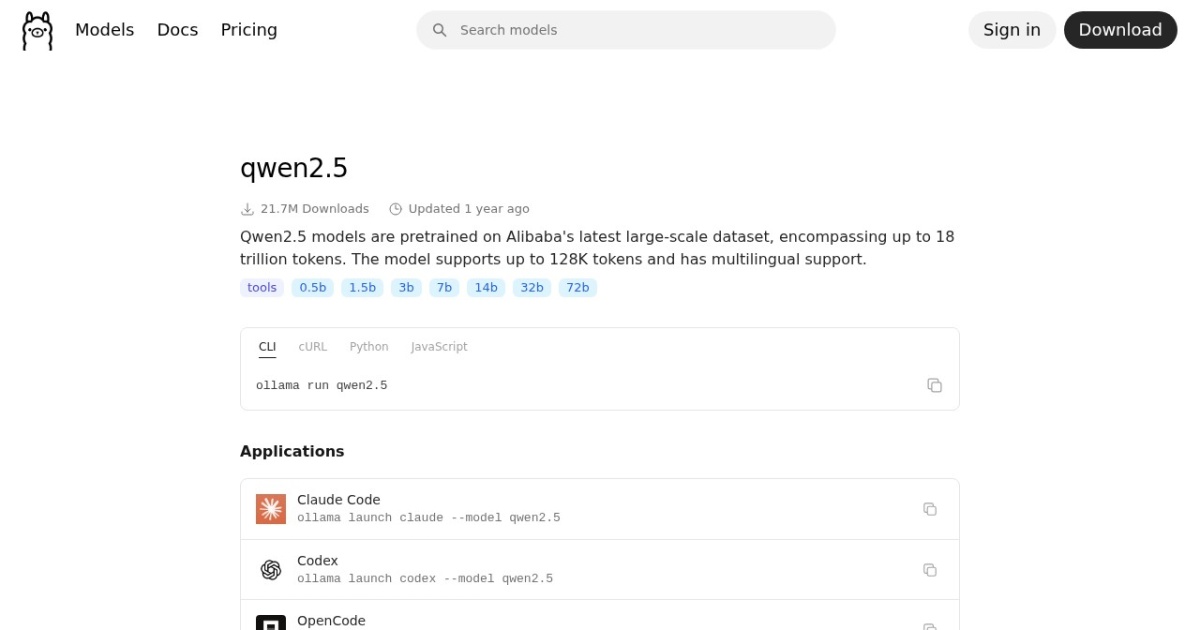
Qwen2.5
Versatile multilingual open model family with strong long-form writing and instruction-following behavior.
Qwen2.5 is a flexible family for solopreneurs who need multilingual output, long-form drafting, and scalable local model options.
Qwen3 8B
Apache-2.0 open-weight 8B model with 128K context, local-first deployment, and optional cloud API access.
Qwen3 8B is one of the most practical local models for solopreneurs: permissive license, broad language support, and strong performance-to-cost balance on commodity hardware. You can run it privately via local inference, or use Qwen cloud options through Alibaba Cloud Model Studio when you need managed API scaling.
Side-by-side comparison
| Dimension | Qwen2.5 | Qwen3 8B |
|---|---|---|
| Pricing model | Free | Free |
| Price range | Free (open weights) | Free (open weights) |
| API cost | No required vendor API cost for local/self-hosted use. | Local: no required vendor API cost. Optional cloud API (Alibaba Cloud Model Studio, pricing page updated 2026-02-11): qwen-max starts at $0.345 input / $1.377 output per 1M tokens; qwen-plus starts at $0.115 input / $0.287 output per 1M tokens (<=128K tier). |
| Subscription cost | No mandatory subscription for base model access. | No fixed Qwen API subscription is listed in Model Studio; API billing is pay-as-you-go by token usage. |
| Pros | • Strong multilingual quality across tasks • Scales from smaller to larger local deployments • Good performance for long-form generation workflows | • Apache-2.0 license supports broad commercial usage • 128K context is practical for multi-document tasks • Hybrid reasoning modes let you trade speed for depth • Strong multilingual support for global workflows |
| Cons | • Larger sizes need significant VRAM headroom • Runtime context still requires careful tuning • Requires QA for factual and business-critical outputs | • Requires local deployment and model-ops basics • Text-only core model line • Output quality still depends on prompt and QA discipline |
| Best for | • Multilingual content generation • Long-form drafting and rewriting • Local assistant workflows with flexible model sizing | • Private local writing and rewriting • Multilingual content transformation • Lightweight offline automation pipelines |
Key difference
Qwen2.5's perspective: Qwen2.5 is the previous generation; Qwen3 8B generally improves reasoning control and instruction quality on more complex prompts.
Qwen3 8B's perspective: Qwen3 8B is the newer generation with stronger reasoning behavior and better control for complex, multi-step instructions than Qwen2.5.
When to pick each
Pick Qwen2.5 when
- Multilingual content generation
- Long-form drafting and rewriting
- Local assistant workflows with flexible model sizing
Pick Qwen3 8B when
- Private local writing and rewriting
- Multilingual content transformation
- Lightweight offline automation pipelines