
VetGeni alternatives
AI scribe for veterinary clinicians — SOAP notes, discharge instructions, treatment plans, drug answers grounded in Wiley references, and PawText client follow-ups. $50/month per doctor (or $500/year), $15/month for students.
This VetGeni alternatives guide compares pricing, strengths, tradeoffs, and related options.
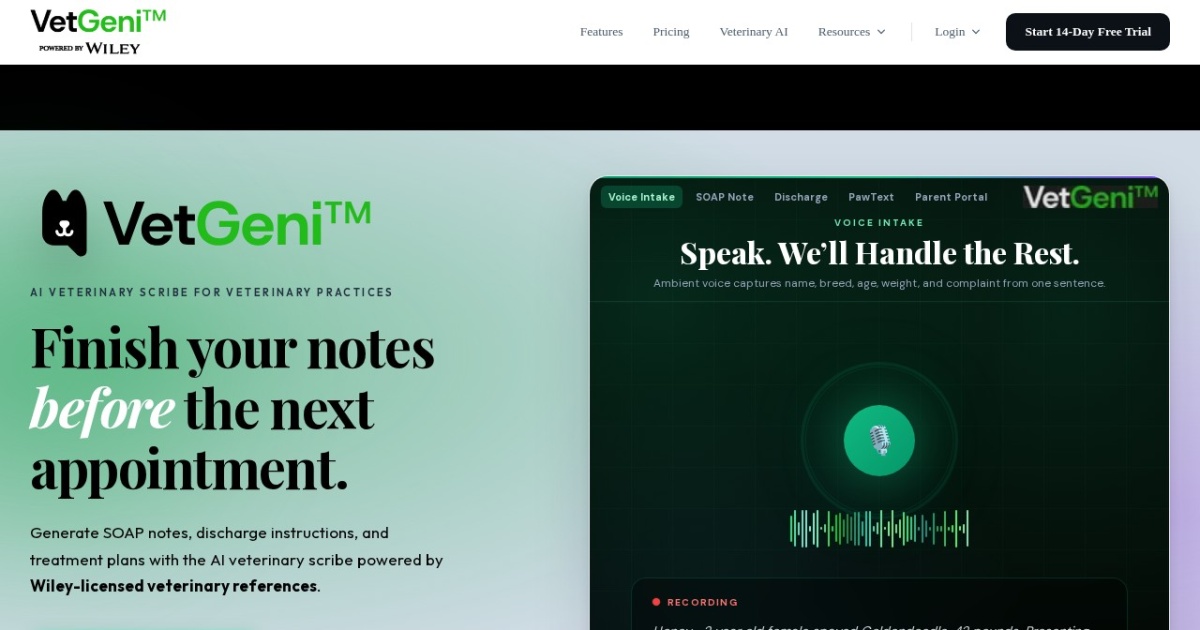
VetGeni is the focused indie pick for veterinary documentation — purpose-built for vet workflow rather than general meeting transcription. The platform generates structured SOAP notes from voice or text, owner-ready discharge instructions with medications and warnings, editable treatment plans with dosing and monitoring guidance, and Wiley-licensed drug-database answers covering toxicology and emergency case support. PawText handles client follow-up messaging, and a Pet Parent Portal gives owners digital visit summaries. The Olivia AI assistant answers veterinary Q&A directly inside the platform. Pricing: $15/month for students (.edu/.ac.uk required), $50/month or $500/year per doctor for professionals, with multi-doctor clinic quotes available. 14-day free trial, no credit card. Target audience: solo veterinarians, multi-doctor clinics, emergency vet practices, and vet students — anywhere clinical documentation burden steals time from patient care.
Official site: https://www.vetgeni.com/
At a glance
| Pricing model | Subscription |
|---|---|
| Page type | Product/service |
| Model source | 3rd-party models |
| Price range | Students $15/month; Professionals $50/month per doctor or $500/year |
| Best for | Solo veterinarians wanting clinical documentation off their plate without learning a general transcription tool, Multi-doctor clinics standardizing SOAP-note quality across the team, Emergency vet practices needing toxicology and dosing answers in the moment, Veterinary students adopting AI workflow early at the $15/month price point, Practices already using Wiley references who want them grounded in their AI tooling |
| Categories | For Solopreneurs , For Small Business , Writing , Automation |
Top alternatives
- Granola : AI notepad for back-to-back meetings — writes alongside your own typed notes during the call, then produces a structured summary without joining as a recording bot.
- tl;dv : AI meeting recorder for Zoom, Google Meet, and Teams — transcription in 30+ languages, AI summaries, timestamp tagging, clip-sharing. Generous free tier with unlimited recordings.
- Anarlog : Open-source on-device AI notepad for meetings — local transcription, BYO API keys, notes saved as portable files. Formerly Hyprnote; canonical brand is now Anarlog.
- Plaud Note : ChatGPT-powered hardware voice recorder + companion app — captures meetings, calls, and memos, then transcribes and summarizes them into mind maps, notes, and to-do lists.
- Surmado : GitHub PR review at flat $15/mo for 100 PRs (10 free monthly), anchored to your STANDARDS.md file. Zero data retention; orchestration architecture blends deterministic code, ML, and LLMs.
Notes
VetGeni is the practical pick for AI-assisted veterinary documentation — particularly when SOAP notes, drug-database answers grounded in clinical references, and client follow-up matter more than general meeting transcription.
Where VetGeni wins
| Job to be done | VetGeni | Granola | Plaud Note |
|---|---|---|---|
| Veterinary-specific SOAP note generation | Built-in templates | Generic notes only | Generic notes only |
| Drug and toxicology answers from clinical references | Wiley-licensed | Not applicable | Not applicable |
| Client-ready discharge instructions with dosing | Built-in | Manual writing | Manual writing |
| General meeting transcription | Less of a focus | Granola wins | Plaud Note wins |
| Standalone hardware recorder | Software only | Software only | Plaud Note wins |
| Student/early-career pricing | $15/month tier | No student tier | No student tier |
Decision shortcuts
- Pick VetGeni when veterinary clinical documentation is the use case — SOAP, discharge, treatment plans, drug references.
- Pick Granola when general meeting notes across non-clinical contexts matter more.
- Pick Plaud Note when a standalone hardware recorder for hands-free capture is the priority.
- Pick Anarlog or tldv when video-call meeting summaries dominate the workflow.
Comparison table
| Tool | Pricing | Page type | Model source | Price range | API cost | Subscription cost | Pros | Cons |
|---|---|---|---|---|---|---|---|---|
| VetGeni | Subscription | Product/service | 3rd-party models | Students $15/month; Professionals $50/month per doctor or $500/year | API access details not surfaced publicly. Platform is operator-facing for individual veterinarians and clinics. | $15/month student tier; $50/month or $500/year per doctor professional tier; multi-doctor clinic quotes on request. | Purpose-built for veterinary workflow — SOAP, discharge, treatment plans, drug-database all in one; Wiley-licensed drug and toxicology references make answers clinically credible vs general AI scribes | Narrow vertical means it does nothing useful outside veterinary medicine; Specific feature depth vs general AI scribes (Granola, Otter) on transcription-only workflows |
| Granola | Freemium | Product/service | 3rd-party models | Free tier with monthly meeting cap + paid Pro and Business subscriptions | API access details not publicly surfaced in 2026. Platform is operator-facing for individual professionals. | Free tier covers low-volume users; Pro tier covers solo professionals at moderate meeting volume; Business tier covers team workflows. | Captures system audio locally rather than joining the meeting as a visible bot — preserves the meeting feel; Designed for the user-still-takes-notes workflow rather than pure transcription replacement | System audio capture only works on platforms with the desktop app installed; Bot-based notetakers (tl;dv, Otter) still beat Granola for asynchronous "I missed the call" use cases |
| tl;dv | Freemium | Product/service | 3rd-party models | Free tier with unlimited recordings + paid Pro and Business tiers for advanced features | API access details vary by tier; check the tl;dv platform docs. | Free tier with unlimited recordings covers most solo professionals. Pro and Business tiers add AI capabilities and team workflows. | Unusually generous free tier — unlimited meeting recordings rather than a monthly cap; 30+ language transcription covers most international team workflows | Joins meetings as a visible bot — some participants find this intrusive; Cloud transcription means audio leaves your environment — privacy-sensitive teams should evaluate |
| Anarlog | Free | Open-source project | 3rd-party models | Free open-source software; user pays underlying LLM provider for summary calls (BYOK) | No vendor API fee. BYOK model means your existing OpenAI/Anthropic/Ollama account handles summary costs. | No subscription required. Donations or commercial-support tiers available; check the project for current options. | Open-source code inspectable on GitHub — privacy claims are auditable rather than asserted; On-device transcription means audio never leaves your machine | Less polished UX than commercial competitors like Granola; Self-hosting requires comfort with installing and updating desktop software |
| Plaud Note | One-time | Product/service | 3rd-party models | Hardware purchase (one-time) + companion app with free tier and paid Pro subscription | No public developer API surfaced. ChatGPT transcription happens via Plaud's cloud, not user's own API key. | Free tier with limited transcription minutes per month; Pro tier lifts the cap. | Hardware-plus-app design covers in-person meetings where laptop notetakers can't reach; Pocket-size form factor fits consultants, sales reps, and field workers | Requires carrying hardware — purely-app competitors (Granola) work on existing devices; Transcription happens in Plaud's cloud, not on-device — not for privacy-sensitive meetings |
| Surmado | Subscription | Product/service | 3rd-party models | Free tier (10 PRs/month) + $15/month flat for 100 PRs | Flat-rate per-month pricing covers API + compute up to the included PR pool. | Free tier with 10 PRs/month covers solo developers; $15/month flat for 100 PRs covers small teams. No per-seat charges. | Flat-rate $15/month for 100 PRs — cheapest per-PR cost among major AI reviewers; STANDARDS.md anchor lets teams write coding rules once and have them enforced consistently | GitHub-only — no GitLab, Bitbucket, or Azure DevOps support; 100-PR monthly cap can bind for high-velocity teams (need to evaluate before scaling) |
Internal links
Related best pages
- Best Free LLMs for Solopreneurs
- Best Free AI Tools for Solopreneurs
- Best AI Automation Tools
- Best AI Email Marketing Tools