
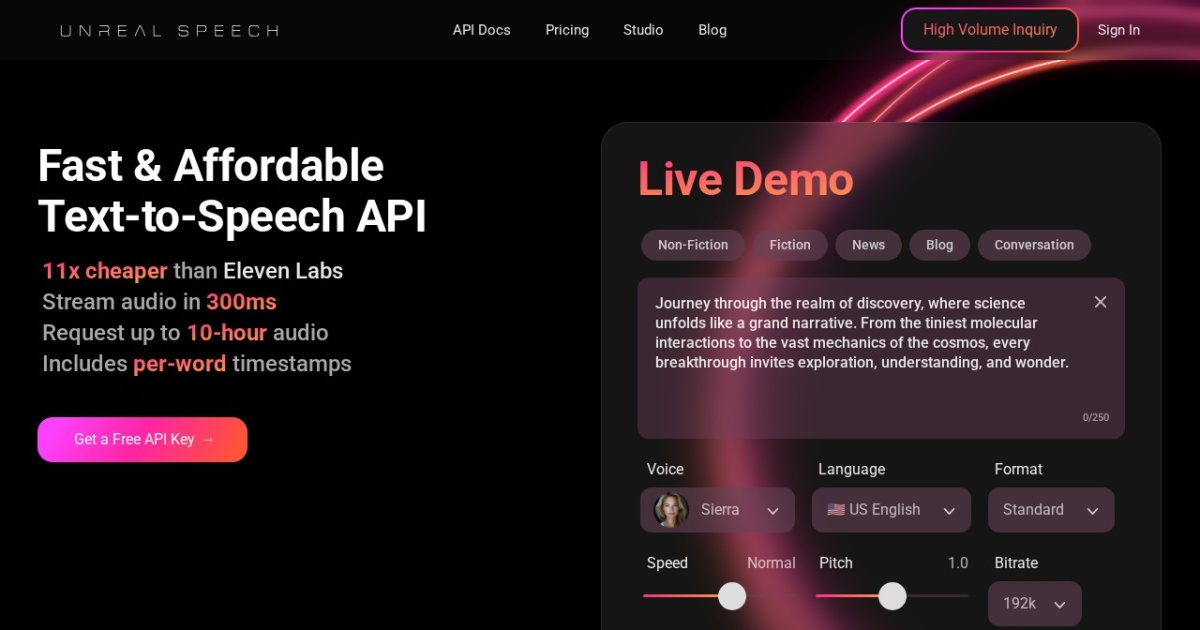
Unreal Speech alternatives
Low-cost text-to-speech API for generating voiceovers and speech at high volume.
This Unreal Speech alternatives guide compares pricing, strengths, tradeoffs, and related options.
Unreal Speech is included in this directory because it focuses on cost-efficient text-to-speech API usage for developers and content teams with large speech generation needs. It is a relevant Altered AI alternative when the requirement is scalable narration generation rather than voice morphing, cleanup, or real-time voice effects.
Official site: https://unrealspeech.com/
Company YouTube: No official company YouTube channel found during official-page review.
At a glance
| Pricing model | Credits |
|---|---|
| Page type | Product/service |
| Model source | Own models |
| Price range | Usage-based API pricing |
| Best for | Developers generating high-volume narration, Product teams adding programmable voice generation, YouTube creators making voiceover-led content |
| Categories | For Creators , Video , Text to Speech , Developers |
TTS feature comparison
| Tool | Languages | Accents | Voice cloning | Voice changing | Local/offline | API access | Notes |
|---|---|---|---|---|---|---|---|
| Unreal Speech | Language coverage depends on currently available Unreal Speech voices. | Voice style and accent coverage depends on the selected voice. | No | No | No | Yes | Best for high-volume narration where unit economics matter. |
| ElevenLabs | Multi-language voice library with broad language coverage. | Broad accent and style coverage depending on selected voice model. | Yes | Yes | No | Yes | Strong all-round option for production voice quality and API workflows. |
| Cartesia Sonic | Sonic supports multilingual speech generation workflows according to Cartesia positioning. | Voice style and accent options depend on selected model and voice controls. | No public details | No | No | Yes | Best for developers building fast spoken interfaces or agent voice experiences. |
| Deepgram | Language coverage depends on the selected Deepgram speech product and model. | Voice options and accents depend on selected TTS voices. | No | No | No | Yes | Strong fit for engineering teams building voice agents, transcription, or speech-enabled products. |
| Resemble AI | Supports multilingual voice generation and localization workflows. | Accent and style control depends on selected or cloned voice. | Yes | Yes | No | Yes | Good fit when voice generation needs to be embedded into an app or pipeline. |
| Play AI | Language coverage depends on current Play AI voices and agent capabilities. | Voice style and accent coverage depends on available voices. | No public details | No | No | Yes | Useful for teams comparing voice agent and TTS platforms. |
| Murf | Multi-language support with provider-managed voice library. | Multiple accent options available across supported language voices. | Partial | Partial | No | Yes | Studio-oriented interface suitable for business narration pipelines. |
Top alternatives
- ElevenLabs : Natural text-to-speech platform for voiceovers and narration.
- Cartesia Sonic : Low-latency generative voice model and API for real-time speech applications.
- Deepgram : Speech AI platform for transcription, text-to-speech, voice agents, and developer voice workflows.
- Resemble AI : Voice cloning, speech-to-speech, text-to-speech, dubbing, and developer API platform.
- Play AI : AI voice platform for conversational voice agents, text-to-speech, and developer speech workflows.
- Murf : Studio-style AI voiceover tool with tone and pacing controls.
Notes
Unreal Speech is worth comparing when the voice workflow is mostly API-driven TTS and cost per generated minute matters more than voice transformation features.
Comparison table
| Tool | Pricing | Page type | Model source | Price range | Pros | Cons |
|---|---|---|---|---|---|---|
| Unreal Speech | Credits | Product/service | Own models | Usage-based API pricing | Cost-focused TTS API positioning; Useful for high-volume narration generation | Not a voice morphing or real-time voice changer; Less suited to dubbing or lip-sync workflows by itself |
| ElevenLabs | Freemium | Product/service | Own models | Free-$330+/mo | Fast setup for solo teams; Useful template support for repeatable workflows | Costs can increase with higher usage; Output quality depends on prompt quality |
| Cartesia Sonic | Credits | Product/service | Own models | Usage-based API pricing | Strong fit for low-latency voice applications; API-first product surface for engineering teams | Not a full post-production voice editing studio; Requires engineering integration |
| Deepgram | Credits | Product/service | Own models | Usage-based API pricing | Production-oriented speech APIs for developers; Covers transcription, TTS, and voice-agent workflows | Not a voice morphing or character voice studio; Requires engineering integration and usage monitoring |
| Resemble AI | Credits | Product/service | Own models | Usage-based and enterprise plans | Developer-friendly API for production voice workflows; Combines TTS, cloning, speech-to-speech, and localization | Requires engineering work for custom pipelines; Usage pricing can be harder to forecast at scale |
| Play AI | Freemium | Product/service | Own models | Free start + paid voice plans | Relevant for conversational voice agents and TTS workflows; Developer-facing positioning fits product integrations | Current product scope should be verified before migration from old PlayHT workflows; Less focused on voice morphing and post-production cleanup |
| Murf | Subscription | Product/service | Own models | $29-$99+/mo | Fast setup for solo teams; Useful template support for repeatable workflows | Costs can increase with higher usage; Output quality depends on prompt quality |
Internal links
Related best pages
- Best AI Voiceover Tools
- Best AI Tools for YouTube Shorts
- Best AI Video Repurposing Tools
- Best AI Tools for Developers 2026